
This dyed yarn sourcing guide explains how textile buyers, garment manufacturers, and importers can source high-quality dyed yarn for apparel and home textile production. Whether you are producing sweaters, knitwear, socks, or yarn-intensive garments, the yarn’s color consistency, fiber quality, and dyeing integrity directly affect your finished product — and your brand’s reputation in the market.
This guide covers everything you need to evaluate dyed yarn manufacturers — from fiber type and certifications to dyeing quality standards and MOQ planning — and introduces Abtex International as a trusted yarn export company based in Pakistan.
Quick Answer for Buyers
- For solid color garments, source cone dyed cotton yarn with approved lab dips, documented fastness, and cone-to-cone shade control.
- For heather or mixed-tone styles, source melange yarn, where colored fibers are blended before spinning.
- For reliable export programs, confirm MOQ, lead time, certifications, packing, and pre-shipment inspection before placing bulk orders.
Table of Contents
- What Is Dyed Yarn?
- Types of Dyed Yarn Used in Textile Manufacturing
- How to Source Dyed Yarn for Apparel Production
- Reactive Dyed vs Melange Dyed Yarn
- MOQ and Lead Time for Dyed Yarn Orders
- Choosing the Right Dyed Yarn Supplier
- Why Buyers Source Dyed Yarn from Pakistan
- Common Sourcing Mistakes to Avoid
- Frequently Asked Questions
What Is Dyed Yarn?
Dyed yarn is yarn that has been colored through a controlled dyeing process before being knitted or woven into fabric. Unlike fabric dyeing (also called piece dyeing), yarn dyeing delivers superior color penetration, more uniform results, and better color fastness — making it the preferred method for structured knitwear and apparel where any shade inconsistency becomes immediately visible in the finished garment.
For sweater and knitwear production specifically, dyed yarn is the standard choice among quality-focused manufacturers. The color is locked into the fiber at the yarn stage, producing rich, even tones that resist fading, pilling, and shade variation throughout the garment’s commercial life.
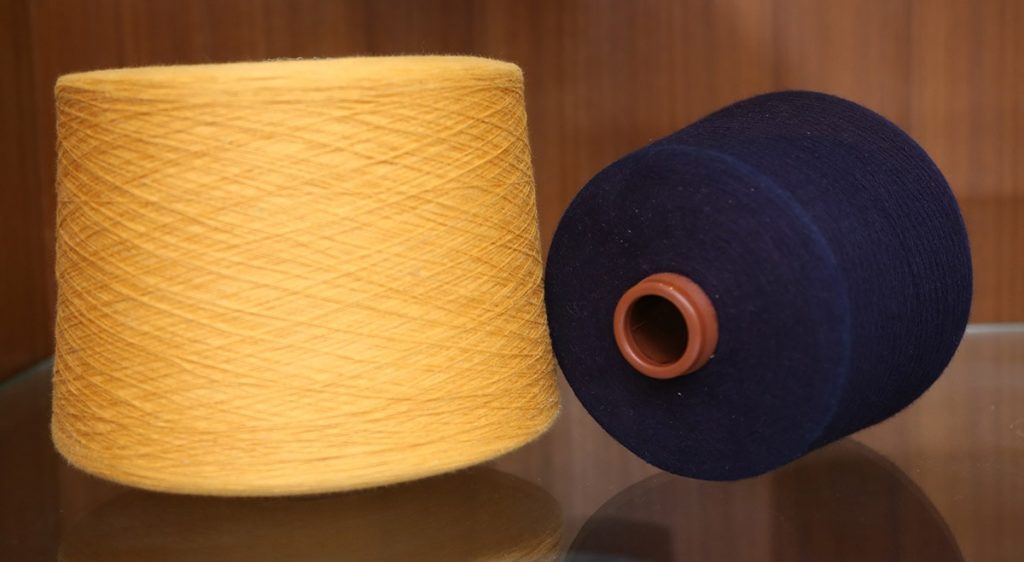
“Yarn dyeing is not simply about color. It is a technical process that, when done well, produces rich, uniform, colorfast results that hold up through repeated washing and wear. When done poorly, it introduces problems that are difficult — and expensive — to fix at later production stages.”
The consequences of sourcing from the wrong supplier show up directly in finished garments: uneven color, streaking, fading after the first wash, or shades that drift from the approved Pantone reference. These issues damage brand reputation and trigger costly returns, reworks, or rejections.
Types of Dyed Yarn Used in Textile Manufacturing
Not all dyed yarn is the same. The base fiber, dyeing method, and certification standard each define a distinct product type with different performance characteristics, cost structures, and end-use suitability. As a dyed yarn manufacturer, Abtex International supplies the following types:
Normal Cotton Dyed Yarn
The industry-standard option for cost-effective, high-volume production. Ideal for buyers prioritizing competitive pricing without compromising basic quality.
BCI Cotton Dyed Yarn
Sourced from Better Cotton Initiative-certified farms. Required by many European and North American brands as part of responsible sourcing commitments.
Organic Cotton Dyed Yarn
Grown without synthetic pesticides, certified to GOTS or equivalent standards. Preferred for baby products, skin-sensitive garments, and eco-conscious collections.
Regenagri Cotton Dyed Yarn
Regenerative agriculture-certified fiber that actively improves soil health and biodiversity. Increasingly required by brands with verified environmental impact commitments.
BCI + Organic Blend
Meets both responsible sourcing and certified organic requirements simultaneously within a single yarn specification.
Organic + Regenagri Blend
A premium combination aligned with the highest sustainability benchmarks — ideal for brands leading on environmental credentials.
BCI + Regenagri Blend
Balances responsible sourcing with regenerative practices. Suited for brands with evolving ESG frameworks and multi-standard procurement policies.
Sourcing Insight
Abtex International also supplies melange yarn for buyers who need heather or mixed-fiber aesthetics alongside their dyed yarn range — useful for brands managing multiple yarn specifications from a single factory partner.
How to Source Dyed Yarn for Apparel Production
Sourcing dyed yarn for commercial apparel production is a sequential process — each decision made early in specification determines the ceiling on what the finished product can deliver. Buyers who understand the workflow ask better questions, catch issues earlier, and build stronger supplier relationships.
Step 1 — Define Your Fiber Base and Certification Requirements
Start with the base fiber: Normal, BCI, Organic, Regenagri, or a blend. This is often dictated by your brand standards, retailer compliance requirements, or destination market regulations. Confirm which certifications your procurement policy requires before entering supplier conversations — discovering mid-development that a supplier lacks a required certification is an entirely avoidable problem.
Step 2 — Specify Your Color Requirements
Provide your Pantone reference (or physical standard) and confirm whether the supplier uses spectrophotometric measurement for color matching. A supplier relying solely on visual assessment introduces unacceptable risk into large-volume programs. Always work through a lab dip approval cycle before committing to bulk — this is the last checkpoint before production.
Step 3 — Define Quality Parameters in the Purchase Brief
A purchase brief that does not specify color fastness ratings, shade tolerance between cones, and shrinkage requirements is not a production specification — it is an invitation for the supplier to define acceptable quality on your behalf. Specify minimum wash fastness (ISO 105-C06 or AATCC 61), rub fastness, and cone-to-cone Delta E tolerance before placing any order.
Step 4 — Confirm MOQ, Lead Time, and Sampling Process
Understand the supplier’s minimum order quantity and lab dip turnaround time before development starts. Build the full timeline backward from your delivery deadline: lab dip rounds + bulk production + shipping transit + buffer. For Pakistan-origin shipments, allow 25–35 days transit to US East Coast and 20–28 days to UK/Europe on top of production lead time.
Step 5 — Request Pre-Shipment Inspection
For large orders, third-party pre-shipment inspection through SGS or Bureau Veritas provides independent confirmation before goods leave the factory. Build this into your procurement process as standard practice — not an optional overhead.
Buyer Note
Abtex International is a yarn export company based in Pakistan with direct factory capability across dyed, melange, and fancy yarn production. No intermediaries — all communication is direct factory engagement. Contact us to start your sourcing conversation.
Reactive Dyed vs Melange Dyed Yarn
Two of the most commonly compared yarn types in knitwear sourcing are reactive dyed yarn and melange yarn. Understanding the difference helps buyers make the right specification choice for their product and avoids costly development mistakes.
| Feature | Reactive Dyed Yarn | Melange Yarn |
|---|---|---|
| Dyeing method | Reactive dyes applied to finished spun yarn | Fiber blended at raw stage before spinning |
| Color appearance | Solid, uniform color across the yarn | Heathered, speckled, or mixed-tone effect |
| Color fastness | Very good — reactive dyes bond covalently with cotton fiber | Excellent — color locked in at fiber stage |
| Color matching | Pantone-matched; lab dip required | Blend ratio adjusted; visual matching to standard |
| Best for | Solid-color knitwear, sweaters, socks | Casual knitwear, t-shirts, athleisure |
| Abtex product page | Dyed Yarn Range | Melange Yarn Range |
For buyers whose collections include both solid and heathered styles, sourcing both dyed yarn and melange yarn from the same supplier simplifies quality alignment, reduces logistics complexity, and enables consistent fiber certification documentation across the full range.
MOQ and Lead Time for Dyed Yarn Orders
Minimum order quantities and lead times are consistently the two variables that create the most serious procurement problems when they are not understood upfront. A realistic grasp of both is the foundation of any dyed yarn program that needs to hit a specific delivery date.
Minimum Order Quantity
Abtex International’s minimum order for dyed yarn is 4 bags (approximately 180 kg). For custom Pantone-matched colors, the minimum is partly driven by dye batch economics — below a certain batch weight, color reproducibility on repeat orders becomes unreliable. Present your total program volume (not just the initial order) early in the conversation to discuss MOQ and pricing structure most effectively.
Lab Dip Timeline
For custom colors, a lab dip cycle is required before bulk production. Lab dips are typically ready within 1–2 weeks from receipt of the Pantone reference. Revision rounds add time; thorough feedback at each stage reduces the number of iterations required overall.
Bulk Production Lead Time
From confirmed purchase order to goods ready for shipment, allow 45–60 days for standard constructions on repeat specifications, and 60–75 days for new custom colors including the lab dip cycle. This covers yarn preparation, dyeing, quality inspection, and packaging.
Shipping and Transit
From Pakistan, approximate ocean freight transit times are:
- US East Coast: 25–35 days
- UK & Northern Europe: 20–28 days
- Middle East: 10–14 days
- East Africa: 14–20 days
Planning Rule of Thumb
Add lab dip time + bulk production lead time + ocean transit + 10 days buffer, then work backward from your delivery deadline to set your production start date. If the math doesn’t work, the sourcing conversation needs to start sooner. Contact us early to plan your program timeline accurately.
Choosing the Right Dyed Yarn Supplier
Choosing the right dyed yarn manufacturer is not just a procurement decision — it is a quality control decision. The supplier you choose sets the ceiling on what your finished product can achieve. Here are the key factors to evaluate:
- Color matching accuracy — Pantone-matched lab dips with spectrophotometric measurement, not visual assessment alone.
- Streak-free dyeing — In-process batch controls during dyeing, not just end-of-line inspection. Ask specifically how they prevent streak defects.
- A-grade base yarn — Carded or combed cotton with consistent count, cleanliness, and tensile strength for better dye uptake and knitting performance.
- Color fastness documentation — Wash and rub fastness test results available on request, to ISO or AATCC standards.
- Fiber certifications — Verifiable certificates (BCI, Organic, Regenagri, GOTS) with certificate numbers that can be cross-referenced against the issuing body’s registry.
- Repeat order consistency — Documented approved specifications filed and referenced on every subsequent purchase order.
- Direct factory engagement — No intermediaries. Communication direct with the manufacturing team for faster resolution of technical questions.
| Question to Ask | Why It Matters |
|---|---|
| What fiber certifications do you hold? | Confirms BCI, Organic, Regenagri claims are independently verified |
| What is your lab dip turnaround time? | Sets realistic development timelines; reveals process discipline |
| What are your wash and rub fastness results? | Confirms performance suitability for your end product |
| How do you inspect for streak defects? | Reveals whether QC is in-process or only end-of-line |
| What is the shade tolerance between cones? | Prevents shade banding in the finished knitted fabric |
| What is your lead time for custom colors in bulk? | Essential for production planning and delivery commitments |
Why Buyers Source Dyed Yarn from Pakistan
Pakistan is one of the world’s leading cotton textile producing and exporting countries, with a fully integrated supply chain from raw fiber through spinning, dyeing, and finished fabric. For international buyers sourcing dyed yarn, Pakistan offers a compelling combination of manufacturing depth, fiber availability, and cost structure that few other origins can match.
Integrated Cotton Supply Chain
Pakistan’s textile industry operates across the full value chain — from cotton cultivation and ginning through spinning, dyeing, weaving, knitting, and garment manufacture. This vertical integration gives buyers the ability to source multiple product types from a single country of origin, simplifying certification chains and reducing logistics complexity. Abtex International, as a yarn export company based in Hyderabad, Pakistan, supplies dyed yarn, melange yarn, fabrics, and blankets from a single manufacturing base.
Cotton Fiber Quality
Pakistan produces high-quality long-staple cotton suited to both carded and combed yarn production. The availability of certified fiber — BCI, Organic, and Regenagri — from within or adjacent to the supply chain gives Pakistan-based spinners a structural advantage over origins that must import certified raw material.
Competitive Cost Structure
Pakistan’s yarn and textile manufacturing cost structure is highly competitive relative to other major export origins, particularly for cotton-based products. For buyers managing price pressure without compromising fiber quality or dyeing standards, Pakistan-origin dyed yarn consistently delivers strong value.
Export Infrastructure
Karachi, Pakistan’s primary export port, has established freight connections to all major markets — US, UK, Europe, Middle East, and East Africa. Container availability, shipping frequency, and transit times are all commercially viable for the volumes and timelines relevant to most international buyers.
About Abtex International
Abtex International (Pvt.) Ltd. is a Pakistan-based yarn export company specializing in Cotton, Melange, Dyed & Poly Cotton yarns, fabrics, and blankets. We supply directly to garment manufacturers, importers, and brands across the US, UK, Europe, Middle East, and Africa. Minimum order: 4 bags (approx. 180 kg). Contact us to discuss your requirements.
Common Sourcing Mistakes to Avoid
These errors appear repeatedly in dyed yarn procurement and each creates downstream problems that are costly and almost entirely avoidable with better upfront process.
01
Selecting a supplier based primarily on price
A supplier quoting significantly below market on custom dyed yarn is either using inferior base fiber, applying shortcuts to the dyeing process, or misquoting a specification they haven’t fully understood. Any of those outcomes costs more to resolve than the initial price saving was worth.
02
Skipping the lab dip approval cycle
The lab dip is the only pre-production opportunity to confirm the supplier can hit your color. Buyers who skip this step and proceed to bulk on verbal assurance regularly encounter shade deviations that are expensive to resolve. Lab dip approval is not optional — it is the quality checkpoint that protects the entire program.
03
Not specifying color fastness standards in the purchase brief
“Good color performance” is not a testable specification. Minimum rating 4 to ISO 105-C06 at 60°C is. Fastness standards should be in the brief from the start — not added after production problems have already appeared.
04
Ignoring shade tolerance between cones
A correctly matched color average means nothing if individual cones within the lot vary enough to produce visible shade banding in the finished fabric. Always specify a maximum cone-to-cone shade tolerance (Delta E value) as a contractual requirement.
05
Treating certifications as given without verification
A claim of “BCI cotton” or “Organic certified” without a verifiable certificate number and issuing body is not a certification — it is an unverified marketing statement. Always cross-reference certificates directly against the certifying organization’s public registry before placing orders.
06
Underestimating total lead time
Lab dip approval, bulk production, and shipping run sequentially — not simultaneously. Build the timeline from your delivery deadline backward, include buffer for revision rounds, and start the supplier conversation earlier than feels necessary.
Frequently Asked Questions
The questions below reflect the most common issues raised by textile buyers, importers, and sourcing teams. If your question isn’t covered here, contact our team directly.
What is dyed yarn and how is it different from piece-dyed fabric?
Dyed yarn is yarn that is colored before it is knitted or woven into fabric. Piece dyeing colors the fabric after construction. Yarn dyeing offers superior color penetration, more uniform results, and generally better color fastness — making it the preferred method for structured knitwear where shade inconsistency becomes visible in the finished garment.
Explore our dyed yarn range to see available options.
Which fiber certifications are available for dyed yarn at Abtex International?
We supply dyed yarn across Normal cotton, BCI, Organic, and Regenagri-certified cotton, as well as blended combinations: BCI + Organic, Organic + Regenagri, and BCI + Regenagri. Buyers with multi-standard sustainability requirements can source everything from a single supplier.
Contact us to confirm current certification status and documentation for your required standard.
What is the minimum order quantity for dyed yarn?
Our minimum order is 4 bags (approximately 180 kg). For custom Pantone-matched colors, the minimum is partly driven by dye batch economics — below a certain batch weight, color reproducibility on repeat orders becomes unreliable. Present your total program volume early in the conversation to discuss MOQ and pricing structure most effectively.
What is a streak defect in dyed yarn, and how do you prevent it?
A streak defect is uneven color variation running along the length of the yarn, caused by inconsistent dye uptake during the dyeing process. Streaks are invisible on the cone but clearly visible once knitted into fabric. Prevention requires in-process quality controls during dyeing — bath temperature monitoring, dye bath ratio consistency, and batch testing before cone winding. We apply quality checks at each stage, not only at end-of-line inspection.
Can you match a specific Pantone color for bulk dyed yarn production?
Yes. Provide your Pantone reference and we will produce lab dips for approval before bulk production begins. Lab dips are typically ready within 1–2 weeks depending on shade complexity and fiber base.
Contact us with your Pantone reference to start the process.
What are the available options for black dyed cotton yarn?
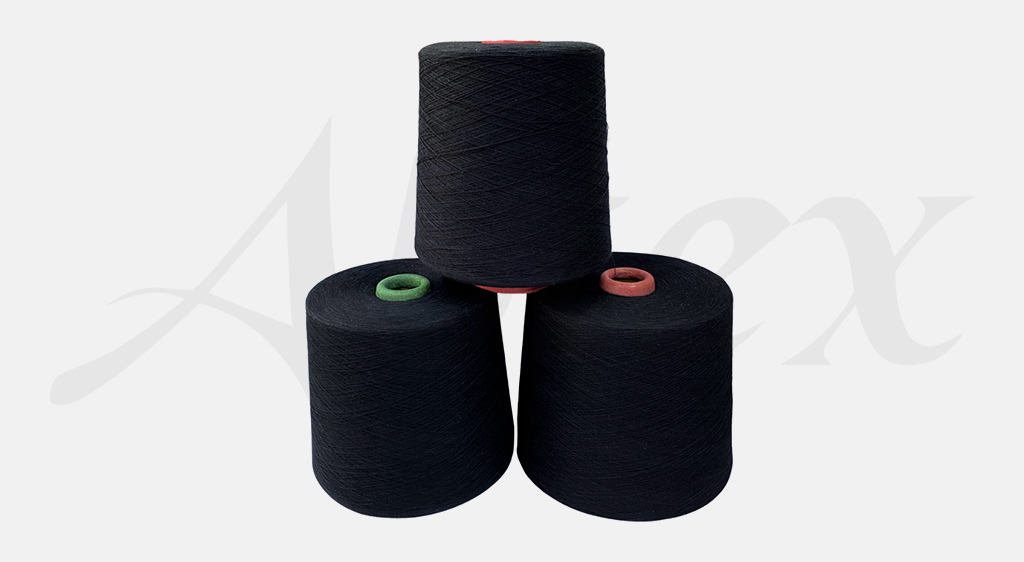
Our black dyed cotton yarn is available across Normal, BCI, Organic, Regenagri, and blended fiber bases. Achieving a true, deep black without undertone shift requires precise dyeing chemistry and consistent quality controls — both built into our production process. Wash and rub fastness documentation is available on request.
What is bleached white cotton yarn used for?
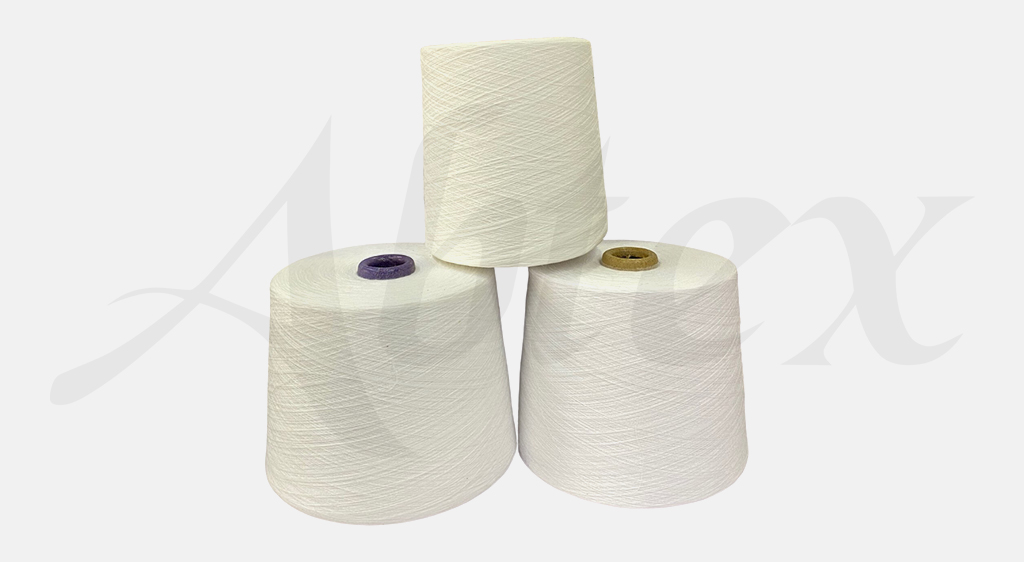
Our bleached white cotton yarn is used for white knitwear production and as the starting material for downstream reactive dyeing processes. A high-quality bleach produces uniform optical brightness without compromising fiber strength — important for both direct knitting and further processing.
What is the difference between dyed yarn and melange yarn?
Dyed yarn is solid-colored yarn produced by applying reactive dyes to finished spun yarn. Melange yarn is produced by blending differently colored fibers at the raw stage before spinning, creating a heathered or speckled visual effect. Dyed yarn is preferred for clean, solid-color knitwear; melange yarn suits casual and athleisure aesthetics. Abtex International supplies both from the same manufacturing base.
Do you supply other textile products alongside dyed yarn?
Yes. In addition to our dyed yarn range, Abtex International supplies melange yarn, fancy yarn, fabrics, and blankets (waffle and thermal constructions) from our manufacturing base in Hyderabad, Pakistan. Buyers consolidating multiple product categories can manage sourcing, certification, and logistics through a single supplier relationship.