
Waffle Blanket Buyer’s Guide: Materials, Specifications and Sourcing
A practical guide for importers, brands, distributors and hospitality buyers comparing materials, construction, GSM, sizing, testing and commercial terms.
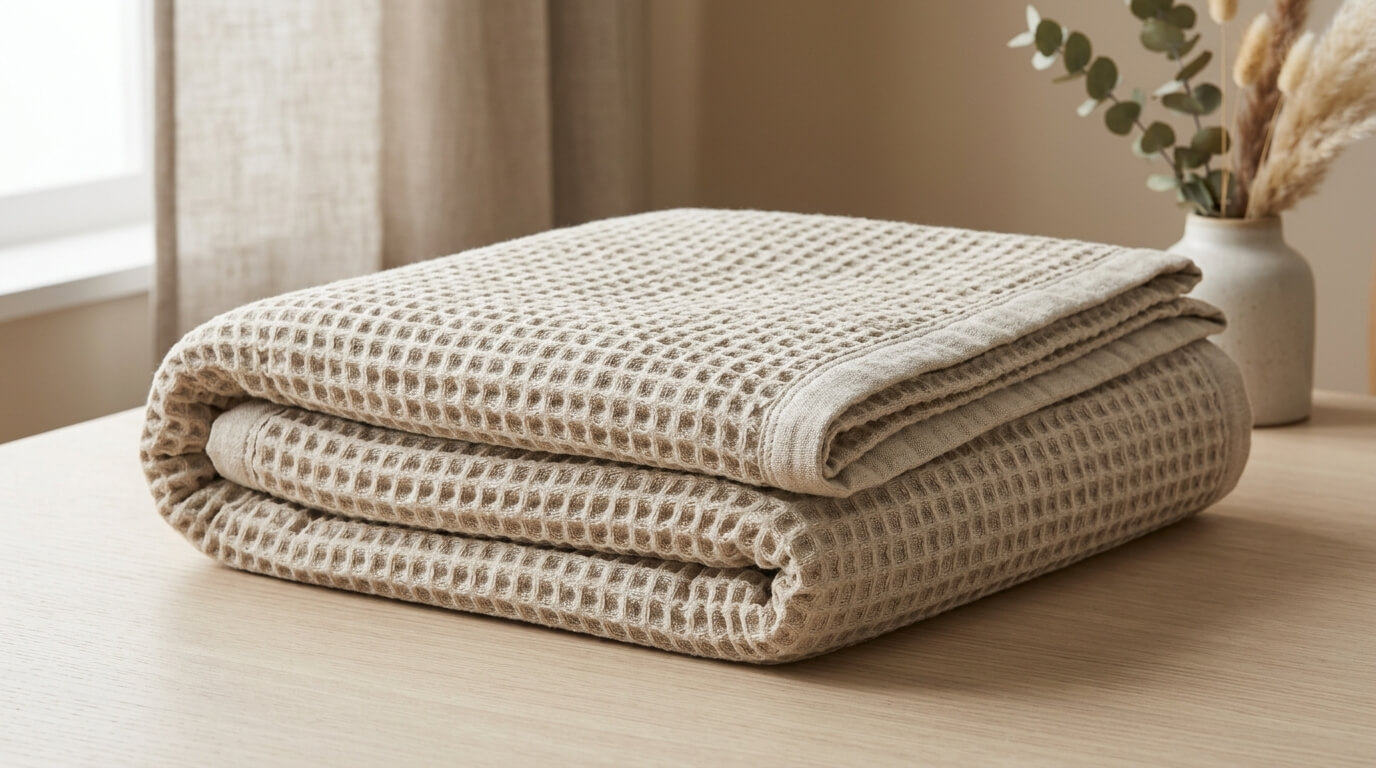
Importers, brands, distributors and hospitality buyers often treat a waffle blanket as a straightforward textile product. That assumption creates avoidable sourcing problems. Two blankets may look nearly identical in photographs yet differ considerably in fibre composition, fabric weight, cell definition, shrinkage, colour performance, finished dimensions and edge construction.
A commercially workable specification must define more than colour and size. Buyers should align the material, construction, finishing, testing, labelling and packing requirements with the intended use and destination market.
This guide explains how to compare cotton and cotton/polyester options, develop an accurate product specification, approve samples and select a suitable manufacturer without relying on vague product descriptions or non-equivalent quotations.
A waffle blanket is a woven or knitted covering with a raised and recessed cellular surface. The correct product depends on its intended use, fibre composition, construction, finished weight, dimensions and care performance.
Every supplier should quote against the same measurable specification. Otherwise, the buyer may receive several prices for technically different products.
What Is Waffle-Textured Blanket Construction?
Waffle-textured construction creates a repeated grid of raised borders and recessed cells. The appearance is sometimes called honeycomb construction, although the two descriptions should not be assumed to represent an identical fabric specification.
The texture is created through controlled yarn interlacing in woven fabric or loop formation in knitted fabric. Construction affects drape, stretch, dimensional stability, surface definition and susceptibility to pulled yarns.
Buyers should identify whether they require a woven or knitted product. A close-up photograph may communicate the desired appearance, but it cannot define yarn specification, GSM, density, shrinkage or construction.
Think of corrugated packaging: two cartons can use similar paper but perform differently because their board weight and flute construction differ. In the same way, cellular blankets with the same fibre content can perform differently because their yarns, density and finishing are not the same.
How a Waffle Blanket Is Made
A waffle blanket is produced through material selection, yarn preparation, fabric formation, dyeing or finishing, cutting, sewing, inspection and packing. Each stage can affect final dimensions, weight, texture and appearance.
Fibre and Yarn Selection
Production begins with an approved fibre composition and yarn specification. Abtex offers cotton and cotton/polyester blend options for this category.
Yarn count, spinning method, twist, ply and evenness influence the surface. A bulkier yarn can create stronger texture, while a finer yarn may create smaller, more refined cells. Develop yarn together with GSM, cell structure, density and finished hand feel.
Fabric Construction
In woven production, warp and weft yarns interlace according to a cellular weave plan. In knitted production, loops create raised and recessed areas.
- Woven or knitted construction
- Fabric or machine width
- Yarn specification and density
- Cell size and usable width
- Continuous-fabric or panel method
Dyeing and Finishing
The product may be natural, bleached, solid-dyed or another approved presentation. Wet processing can change width, length, GSM, hand feel and cell definition, so specifications should refer to finished—not greige—measurements.
Descriptions such as “soft finish” are subjective. Support them with an approved physical sample and measurable requirements where needed.
Cutting and Edge Construction
Finished products may use turned hems, stitched hems, binding or another approved treatment. Confirm border width, corners, seam allowance, stitch type and density, sewing thread, label position, dimensions and workmanship variation.
The border must remain compatible with the main fabric after washing, or uneven shrinkage may cause puckering, twisting and distorted edges.
Inspection and Packing
Final inspection should cover dimensions, weight, shade, cell consistency, holes, pulled yarns, stains, sewing defects, labels, folding and packaging.
Packing should protect the texture from compression, moisture and contamination. Test carton dimensions and folding before bulk production because heavy compression can temporarily flatten the cellular surface.
Waffle-Textured Blanket Specification Framework
A complete specification converts the buyer’s intended product into measurable acceptance criteria.
Material Composition
State exact fibre percentages. “Cotton blend” is incomplete. Labels, invoices and product pages must match the finished product.
Construction and Visual Standard
Define woven or knitted construction, cell dimensions and depth, face and reverse, borders, surface uniformity, pulled-yarn standard and approved reference.
Finished GSM
Specify target finished GSM, tolerance, test method, conditioning and whether the result applies before or after washing. Higher GSM does not automatically mean better quality.
Dimensions and Tolerances
State width and length, measurement points and conditions, positive and negative tolerance, before- or after-wash status and whether borders are included.
Shrinkage and Shape Retention
Define dimensional change after the agreed care process. Also inspect skew, edge distortion, cell deformation, seam puckering, twisting and surface change.
Colour and Appearance
Identify the colour master, viewing conditions, lot variation, required test methods and pass grades for washing, rubbing, light and packaging migration where applicable.
Surface Durability
Evaluate pilling, snagging, abrasion, yarn pull-out, seam security and appearance after repeated washing according to intended use.
Care Instructions
Base care guidance on the complete finished product. Incorrect washing or drying directions can cause avoidable returns, complaints and damage.
Sampling, Minimums and Lead Time
Confirm sample stages, charges, development time, MOQ, colour minimums, bulk lead time, approvals, payment terms and the event that starts lead-time calculation.
Packaging and Incoterms
Specify packaging, inserts, barcodes, warnings, carton dimensions, weight limits, marks and pallets. Every quotation should identify the Incoterm and named port or place.
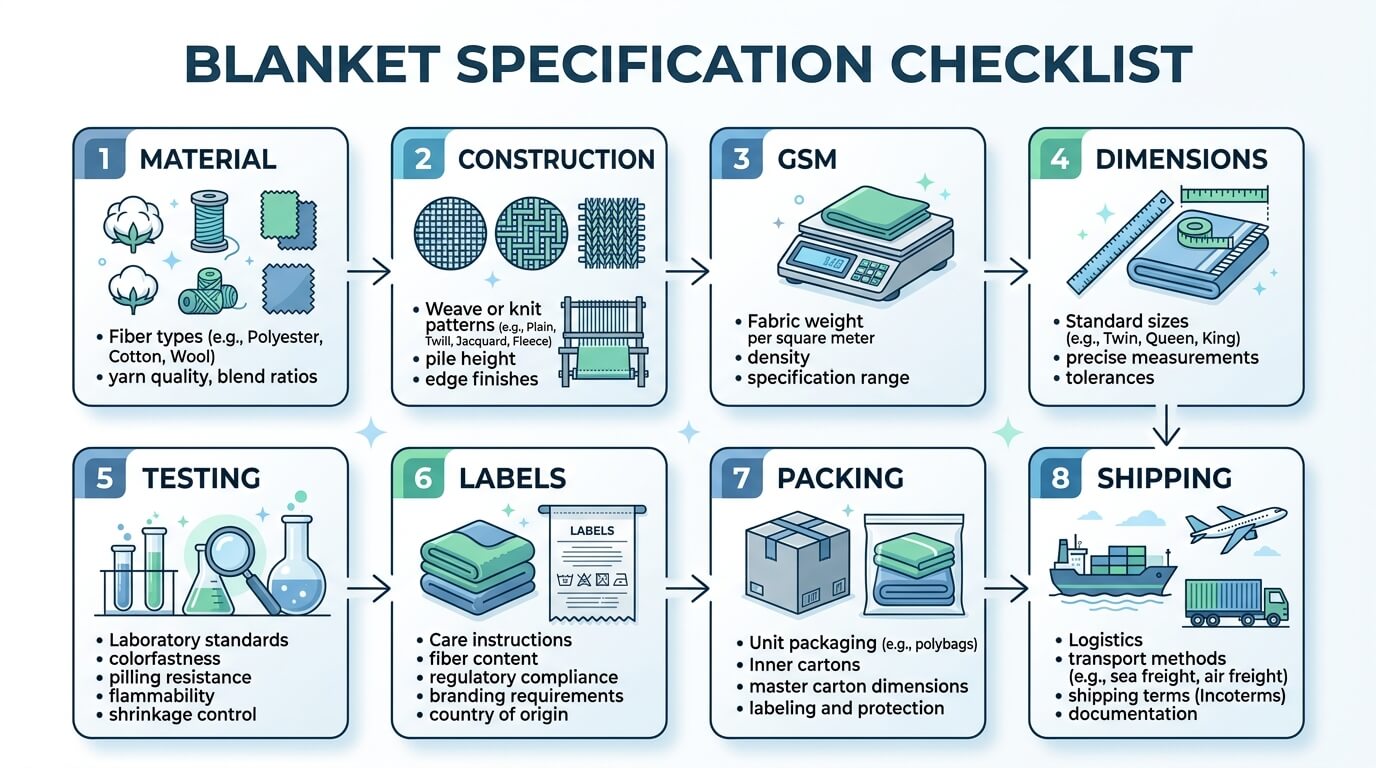
Destination-market compliance: United States buyers should review the FTC’s textile and wool labelling guidance. UK buyers should review the government’s textile labelling guidance. EU programmes should be checked against Regulation (EU) No 1007/2011 and destination-language requirements. The importer remains responsible for confirming the exact current requirements of each market.
Care and shipment references: The FTC’s Care Labeling Rule guidance applies specifically to textile wearing apparel and certain piece goods and is separate from broader household-textile labelling. For commercial terms, review the International Chamber of Commerce’s Incoterms rules.
Cotton and Cotton/Polyester Options Compared
Neither material option is universally superior. The correct choice depends on desired feel, care behaviour, price position, end use and brand strategy.
| Option | Main advantages | Main limitations | Suitable applications | Buyer considerations |
|---|---|---|---|---|
| 100% cotton | Natural-fibre positioning, absorbent handle and familiar consumer acceptance | Requires careful shrinkage, weight and drying control | Retail home textiles, lifestyle and natural-material programmes | Confirm composition, shrinkage, colour and hand feel |
| Cotton/polyester blend | May support dimensional control, quicker drying and cost engineering | Exact percentages must be disclosed; feel differs from all-cotton | Hospitality, value, promotional and easy-care programmes | Confirm blend ratio, pilling, labelling and market acceptance |
| Woven cellular | Structured appearance and clearly defined woven grid | Loose floats or unsuitable yarns can increase snagging | Bed blankets, throws and structured retail programmes | Confirm weave plan, density, edge stability and after-wash appearance |
| Knitted cellular | Flexible drape and stretch can be developed | Dimensional and edge control may need more attention | Lightweight, baby, casual and fashion-led programmes | Confirm gauge, loops, panel method, sewing and shrinkage |
A retailer prioritising natural-material positioning may prefer cotton. A hospitality or value programme may consider a blend where drying time, dimensional behaviour and cost matter. In either case, the finished construction must be tested; fibre composition alone does not guarantee performance.
Illustrative Procurement Scenario
This procurement scenario is not a verified Abtex customer case study.
A home-textile importer plans a private-label launch in several markets. Its first request asks for a “soft cotton cellular blanket” in two sizes and four colours. The description does not define whether cotton means 100% cotton, the construction, GSM, cell size, shrinkage, packaging or destination-market labels.
The buyer improves the request by issuing one specification containing:
- Exact fibre composition
- Finished dimensions
- Target GSM and tolerance
- Approved cellular reference
- Hem construction
- Colour standards
- Testing requirements
- Care wording
- Barcode and label positions
- Packaging and Incoterm
The supplier develops the construction sample first. Colour samples follow after construction approval. The buyer checks both unwashed and laundered samples, and bulk production begins only after material, measurements, texture, shade, labels and packaging are approved.
Commercial lesson: sample approval should verify the complete specification, not merely confirm that the product resembles a photograph.
Common Sourcing Mistakes and Procurement Risks
Most costly sourcing problems begin with incomplete specifications rather than obvious manufacturing failures.
A lower quote may use different GSM, composition, tolerance, border or packing.
Prevention: Compare technically equivalent quotations and landed cost.
The supplier cannot quote a controlled construction and compositions may vary.
Prevention: State exact fibre percentages.
Surface, dimensions, edges and shade may change after laundering.
Prevention: Approve appearance and measurements after the agreed care process.
More weight does not ensure softness, stability or surface performance.
Prevention: Evaluate weight, yarn, construction and finishing together.
FOB and CIF include different costs, risks and responsibilities.
Prevention: Compare the same Incoterm and named destination.
Fibre, origin, care, barcode and responsible-party information affect label design.
Prevention: Approve artwork before bulk sewing.
Organic, recycled, antibacterial, hypoallergenic and certified claims require evidence.
Prevention: Do not publish claims without verification.
How to Select a Waffle-Textured Blanket Supplier
A suitable supplier should demonstrate control over specifications, sampling, production, quality assurance, documentation and delivery.
- Can it produce the required composition and construction?
- Does the quote identify finished GSM, dimensions and tolerances?
- Can it explain yarn, fabric, dyeing and sewing controls?
- Is there a documented sample-approval sequence?
- Can testing follow the buyer’s required methods?
- Are material, dye and production lots traceable?
- Does the plan include in-line and final inspection?
- Can labels and packing be adapted for each market?
- Are MOQ, lead-time triggers and payment terms clear?
- Does the quote state the Incoterm and named port?
- Can it investigate and correct non-conformities technically?
Buyers reviewing custom waffle blanket options should submit the target market, composition, size, GSM, colours, quantity, testing and packaging requirements with the initial enquiry. Learn more about Abtex’s quality-control approach, explore the complete blanket range, or review custom blanket manufacturing.
Conclusion and Key Takeaways
The correct waffle blanket specification balances material, construction, GSM, dimensions, care performance, compliance and commercial terms. Buyers should not approve the product from appearance, price or GSM alone.
- Define exact fibre percentages
- Identify woven or knitted construction
- Specify finished GSM, dimensions and tolerances
- Approve samples after the agreed care procedure
- Confirm destination-market labels and packaging
- Compare suppliers against one specification and Incoterm
A detailed request for quotation reduces pricing gaps, sample revisions and bulk-production disputes.
Frequently Asked Questions
What specifications should a buyer provide for a waffle blanket?
Define fibre percentages, woven or knitted construction, finished GSM, dimensions, tolerances, colour, shrinkage, border, labels, packing and shipment terms. A photograph helps but cannot replace measurable requirements.
Is 100% cotton better than a cotton/polyester blend?
Neither is automatically better. Cotton supports natural-fibre positioning, while a blend may serve dimensional, drying or cost objectives. Compare tested finished products rather than fibre names alone.
Does a higher GSM mean a better blanket?
Higher GSM means more mass per square metre, not automatically better quality. Yarn, construction, finishing, dimensions and intended use determine whether the weight is appropriate.
Should buyers test the product after washing?
Yes. Check dimensional change, cell definition, shade, staining, edge distortion, pilling and overall appearance after the agreed wash and drying procedure.
What information is needed for an accurate quotation?
Include composition, construction, size, GSM, colours, quantity, testing, labels, packing, destination and Incoterm.
Send your destination market, composition, dimensions, GSM, colours, quantity, testing, packaging and preferred Incoterm to Abtex International.