
Thermal Blanket Buyer’s Guide: Materials, Specifications and Sourcing
A commercial guide for importers, retailers, hospitality suppliers, institutions and private-label brands comparing materials, weight, construction, testing and packaging.
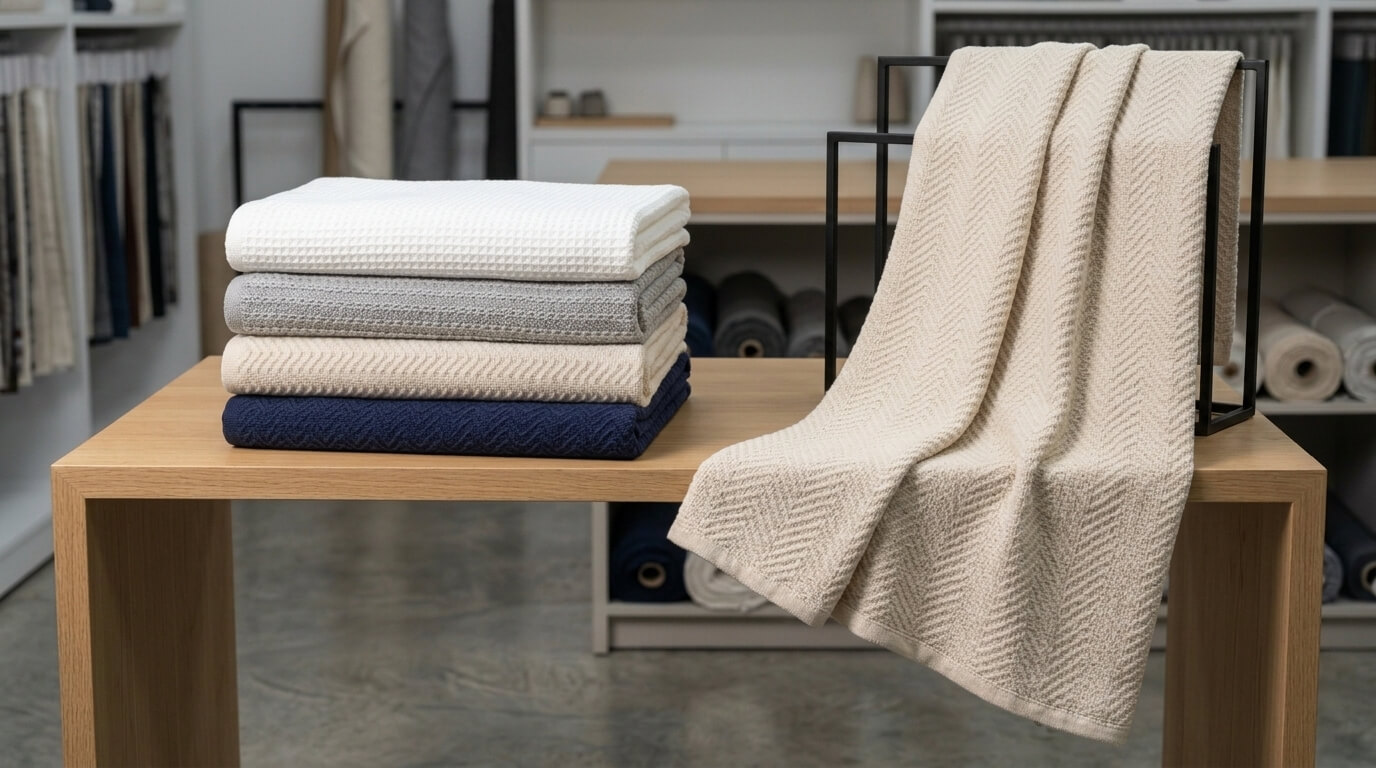
Importers and private-label brands often request a thermal blanket using only a size, colour and target price. That is not enough to obtain comparable quotations or consistent bulk production.
A commercially complete specification must also define fibre composition, construction, finished weight, dimensional tolerances, laundering performance, edge finishing, labelling and packaging. Without these details, two suppliers may quote products that appear similar but differ materially in weight, durability, shrinkage and end-use suitability.
This guide explains how buyers, importers, retailers, hospitality suppliers and institutional procurement teams should evaluate thermal blankets before approving samples or placing bulk orders for the USA, Canada, UK, Europe, Australia and Middle East markets.
A thermal blanket is a non-electric textile blanket designed to provide warmth and breathable comfort through its fibre composition, weight and structured fabric construction.
Select the specification according to climate, intended use, laundering method, retail positioning and target cost.
What Is a Thermal Blanket?
A thermal blanket is a reusable textile blanket engineered to balance warmth, air circulation and everyday use. In home textiles, the term normally refers to a woven or knitted blanket rather than an electric blanket, disposable emergency foil or insulated technical covering.
The construction commonly contains raised areas, cells or controlled spaces that help retain still air while remaining more breathable than a dense, compact fabric. However, “thermal” is not a complete specification. Warmth can be influenced by fibre, yarn size and twist, construction, thickness, finished weight, finishing, air permeability, laundering history and layering during use.
A heavier blanket is not automatically warmer in every condition. Likewise, blankets with the same GSM can perform differently when their yarn, structure, thickness or finishing differs.
Thermal Blankets Versus Waffle Blankets
A waffle blanket is generally identified by a visible square or honeycomb-style texture. Thermal constructions may also have cells or raised structures, but their specification is usually developed around finished weight, comfort and intended bedding performance.
Waffle blankets may suit decorative throws and breathable layered bedding, while thermal constructions may suit bedding, hospitality or institutional programmes requiring defined finished weights. Abtex offers both categories within its broader blanket range.
How Thermal Blankets Are Manufactured
Thermal blanket production follows a controlled sequence from yarn selection to packing. Every stage can affect dimensions, appearance, hand feel and laundering performance.
Fibre and Yarn Selection
Common options include 100% cotton, cotton-rich compositions, cotton/polyester blends and buyer-approved custom blends. Cotton is often selected for softness and absorbency; polyester may be blended where the buyer requires a different balance of durability, drying, dimensional stability and cost.
Do not approve the phrase “cotton blend” without percentages. State the exact ratio in the specification and product label.
Fabric Construction
Woven blankets interlace warp and weft yarns; knitted blankets use interconnected loops. Knitted styles may provide more stretch or a different surface, but buyers must assess stability and snagging risk.
Abtex’s range includes woven thermal constructions and decorative knitted options for bedding, hospitality and private-label programmes.
Colouration and Wet Processing
Blankets may be natural, white, pastel or solid-dyed. Select the process according to composition, shade, colourfastness, care instructions, laundering and lot consistency. Approve a physical swatch, lab dip or recognised colour reference before bulk production.
Finishing
Soft finishing, pre-washing, tumble finishing and mechanical treatment can affect hand feel, appearance, dimensions and surface condition. Evaluate the finish after the intended laundering cycle rather than only on the first sample.
Cutting and Edge Finishing
Options include folded hems, bound edges, overlocking, decorative borders and integrated knitted borders. Define seam appearance, stitch density, thread colour, corner construction and acceptable edge waviness.
Inspection and Testing
Verify dimensions, weight, composition, shade, surface defects, seams, labels and packaging. Testing may cover laundering, dimensional change, colourfastness, strength, pilling or thermal resistance. Review Abtex’s quality-control approach.
Labelling and Packing
Define brand, fibre, origin, care, barcode, size and carton labels together with packaging, assortment and carton markings. Approve artwork before production.
Thermal Blanket Specification Framework for Buyers
A complete specification should allow several suppliers to quote the same product and give inspectors measurable acceptance criteria.
Intended Application
State residential, hotel, hospital, care, student, institutional, retail or promotional use. Commercial laundering may require different criteria from a decorative throw.
Finished Size and Tolerance
State dimensions, measurement method, conditioning, positive and negative tolerance, before- or after-wash status and border inclusion. Avoid relying only on single, twin, queen or king names.
Finished Weight and GSM
Use finished blanket weight with dimensions and construction. GSM supports fabric control but does not fully account for hems, borders, moisture and finishing.
Fibre Composition
State exact percentages and clarify whether borders or decorative components use different materials. Example ratios are specification formats, not standard Abtex ratios.
Construction Details
Approve woven or knitted structure, yarn, density, pattern, thickness, border, edge finish, weight and physical reference sample.
Laundering and Stability
Define wash and drying methods, then test length and width change, distortion, curling, pilling, seams, colour and surface appearance.
Colourfastness
Specify washing, dry and wet rubbing, staining and repeated-laundering requirements according to shade and end use.
Thermal Performance Claims
Support measurable warmth or resistance claims using an agreed laboratory method. Do not turn a test result into an unsupported universal-comfort claim.
Sampling and Approval
Control construction, colour, size, weight, wash testing, labels, packaging, pre-production sample and bulk inspection with dated sample references.
Commercial and Shipment Terms
State quantity by size and colour, packing, labels, shipment window, inspection, destination and Incoterm. CFR is the formal term often called CNF informally.
The result may not fully reflect hems, borders, moisture, finishing variation or structural differences. For this reason, buyers should usually specify the total finished blanket weight as well as dimensions and relevant GSM.
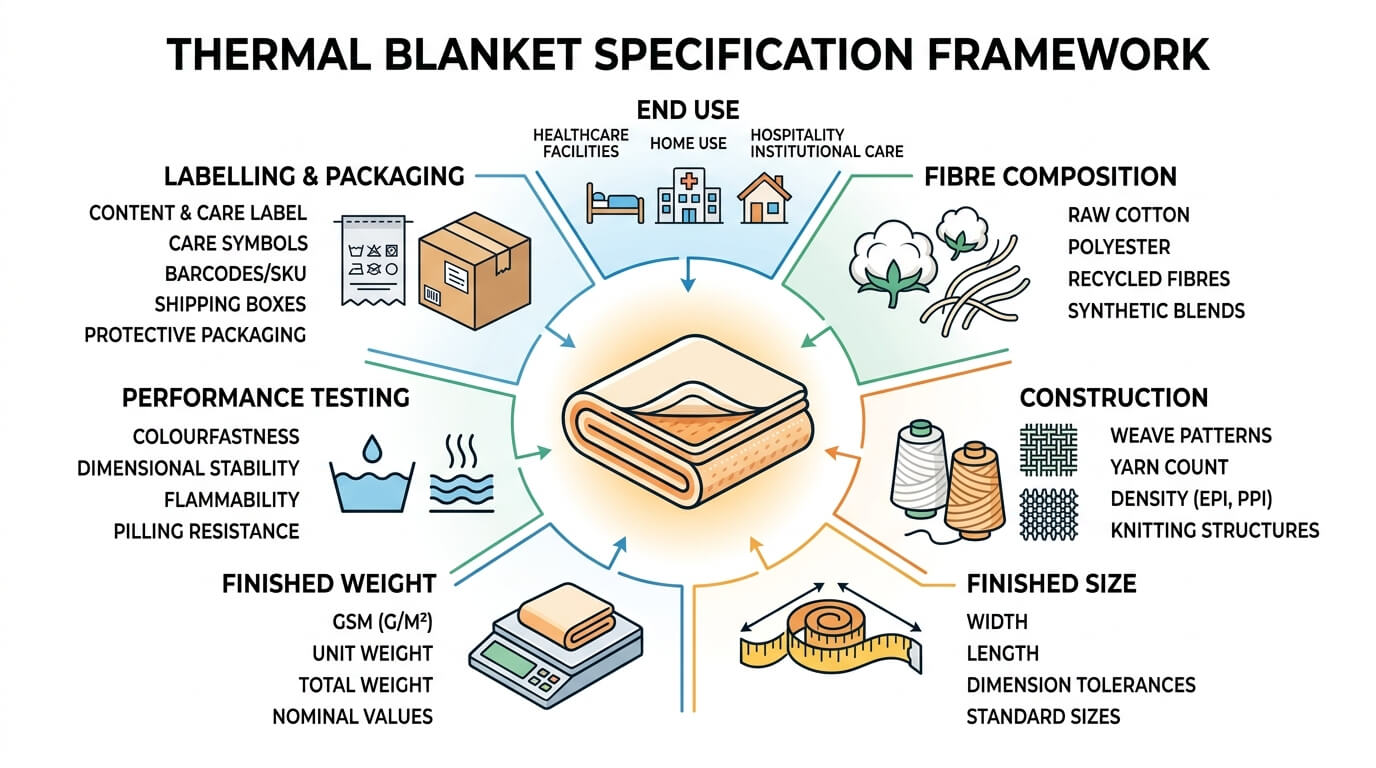
Thermal testing: ISO 11092:2026 specifies measurement of thermal and water-vapour resistance under steady-state conditions using a sweating guarded-hotplate. Its test conditions do not represent specific comfort situations or establish physiological-comfort claims.
Market labelling: US programmes should review the FTC’s Textile and Wool Acts labelling guidance. Canadian buyers should review the Competition Bureau’s Textile Labelling and Advertising guide. UK programmes should review government textile-labelling guidance, and EU programmes should check Regulation (EU) No 1007/2011. Importers remain responsible for current destination-market compliance.
Incoterms: Compare offers using the same rule and named port or place. Refer to the International Chamber of Commerce’s Incoterms rules.
Comparison of Thermal Blanket Material Options
No fibre composition is universally superior. The correct option depends on hand feel, care requirements, performance and commercial positioning.
| Option | Main characteristics | Advantages | Limitations | Suitable applications | Buyer considerations |
|---|---|---|---|---|---|
| 100% cotton | Natural-fibre construction | Soft hand, absorbency and natural positioning | Requires controlled shrinkage and finishing | Retail bedding, hospitality and natural-fibre collections | Test shrinkage, colourfastness and post-wash appearance |
| Cotton-rich blend | Cotton remains the main fibre with polyester support | Balances cotton character with blend performance | Hand depends on ratio, yarn and finishing | Hospitality, retail and private label | State exact percentages and approved hand |
| Poly-cotton blend | Cotton and polyester to buyer specification | May support durability, drying and dimensional control | Lower cotton changes absorbency and positioning | Institutional, hospitality and cost-sensitive programmes | Compare equivalent weights and compositions |
| Waffle blanket | Visible cellular texture | Decorative, breathable surface | May snag if construction is unsuitable | Throws, retail bedding and hospitality | Evaluate snagging, shrinkage and cell definition |
| Decorative knitted | Loop-based knitted structure | Flexible styling and distinctive retail appearance | Requires stretch, pilling and snag control | Private-label and decorative collections | Approve recovery and laundering behaviour |
A low-cost blanket that loses dimensions, shade or surface quality after laundering can create returns, claims and replacement costs. Compare technically equivalent products rather than selecting by price alone.
Illustrative Procurement Scenario
This scenario does not represent a verified customer case study.
A European importer initially requests “a soft cotton thermal blanket in three sizes.” Before pricing, the specification is expanded to include exact dimensions, cotton-rich composition, finished weight, neutral colour range, dimensional-change limit, stitched edges, labels, retail packaging, carton assortment, inspection and CFR quotation to a named port.
The supplier develops a construction sample and wash-tested sample before the pre-production approval.
Commercial lesson: a detailed specification makes quotations comparable and reduces changes after production starts.
Company Perspective
A productive sourcing discussion should begin with measurable requirements rather than a photograph and target price alone.
Abtex International develops cotton and cotton/polyester thermal blanket manufacturing options according to buyer-specified size, finished weight, colour, construction, finishing and packing. Options include bulk, carton, polybag, insert-card and private-label packaging.
Common Thermal Blanket Procurement Mistakes
The lowest quote may represent a lighter product, different blend, weaker construction or simpler packaging.
Prevention: Compare line by line against one controlled specification.
GSM alone does not define total product weight because dimensions and finishing matter.
Prevention: State dimensions and finished blanket weight.
Without tolerances, inspectors have no objective acceptance criteria.
Prevention: Define size, weight and shade variation before production.
Hand, dimensions, colour and surface may change after laundering.
Prevention: Approve after the intended care process.
A cotton-rich product is not equivalent to a lower-cotton poly-cotton blanket.
Prevention: Require exact fibre percentages.
Poor edges can cause waviness, twisting, seam failure and inconsistent appearance.
Prevention: Approve hems, borders, thread and corners physically.
Incorrect composition, care or market information may require replacement.
Prevention: Complete compliance review before artwork approval.
“Winter grade” or “thermally proven” requires objective support when used measurably.
Prevention: Match claims to documented evidence.
How to Select a Thermal Blanket Supplier
A suitable supplier should demonstrate control over product development, testing, production communication and export documentation.
- Can it develop to defined weight and size?
- Does the quote state exact composition?
- Can it explain woven or knitted construction?
- Are tolerances and tests documented?
- Can samples follow the intended wash process?
- Is colour controlled against a standard?
- Are labels and packing checked before bulk?
- Can it provide inspection documentation?
- Are MOQ and lead-time assumptions clear?
- Are terms linked to a named port?
- Are production changes communicated?
- Can it reproduce the approved sample?
Do not evaluate capacity using only a maximum-output claim. Confirm the supplier can produce the required construction, size mix, colours and packaging within the shipment window.
Conclusion and Key Takeaways
A thermal blanket should be purchased as a controlled textile specification, not as a generic warm blanket.
- Define exact fibre composition
- Specify dimensions, tolerances and weight
- Approve construction, hand and edges physically
- Test laundering before bulk production
- Verify market labels before printing
- Compare identical supplier specifications
Once these variables are controlled, buyers can make valid comparisons between cotton, cotton-rich, cotton/polyester, waffle and decorative knitted options.
Frequently Asked Questions
What information is required for a thermal blanket quotation?
Provide finished dimensions, finished weight, fibre composition, construction, colours, packaging, quantity and destination.
Is cotton better than a cotton/polyester blanket?
Neither is automatically better. Cotton may suit natural-fibre positioning, while blends may serve different durability, drying, dimensional-control or cost objectives.
Should buyers specify GSM or total blanket weight?
Normally specify finished dimensions and total finished weight. GSM can support construction control, but total weight gives a clearer comparison of complete blankets in the same size.
How should thermal blankets be tested before bulk production?
Testing should reflect use and care. Buyers commonly evaluate dimensions, weight, shrinkage, colourfastness, surface appearance, strength, pilling and edge condition after laundering.
Can thermal blankets use private-label packaging?
Yes. Buyers should provide approved labels, barcodes, carton markings, packing quantities and destination-market information before bulk production.
Send your required sizes, finished weight, composition, construction, colours, quantity, labels, packing, destination and shipment term to Abtex International.