
Thermal Blanket vs Waffle Blanket: What Is the Difference?
Compare construction, warmth, airflow, GSM, washing performance and commercial use before approving a wholesale blanket specification.
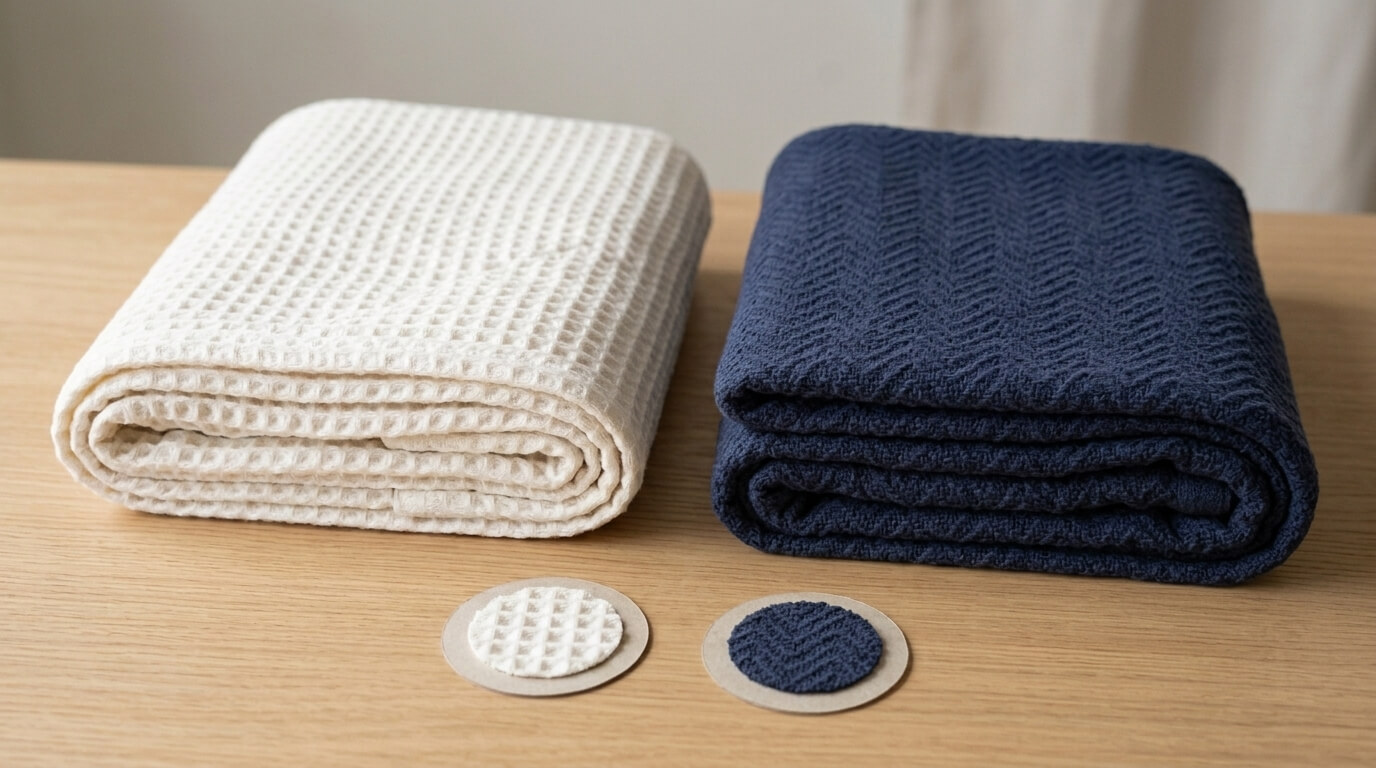
Selecting between a thermal blanket and a waffle blanket is not simply a matter of choosing the warmer-looking product. Importers, hospitality buyers, healthcare procurement teams, distributors and private-label brands must compare construction, fibre composition, GSM, airflow, washing performance, finishing, appearance and total landed cost.
Both products may have a cellular or textured surface and can appear similar in photographs. Waffle constructions are generally selected for decorative honeycomb texture, breathable feel and premium bedding presentation. Thermal constructions normally place greater emphasis on practical warmth, durability and institutional or cold-weather use.
At a Glance: Thermal Blanket vs Waffle Blanket
A defined square or honeycomb surface offering decorative texture, an airy feel and strong home-textile presentation.
A cellular woven or knitted construction intended to hold air and support practical insulation, handling and repeated use.
The correct choice depends on the climate, required warmth and air permeability, fibre composition, finished GSM, product weight, laundering programme and retail or institutional positioning. Buyers should not select either product from appearance or GSM alone.
Buyer rule: Evaluate the physical sample, construction, thermal resistance, wash performance, shrinkage, pilling and finished dimensions together.
Understanding the Two Constructions
What Is a Waffle Construction?
A waffle construction is a woven or knitted textile with raised ridges and recessed cells arranged in a regular square or honeycomb pattern. Its three-dimensional texture can be created through controlled yarn interlacing, floats, tucks or dobby movement.
The structure creates visual depth and small air spaces. Waffle blankets can therefore feel substantial without the fully dense surface of a conventional flat weave.
What Is a Thermal Construction?
A thermal construction is designed to retain air within a cellular, raised or recessed textile structure. Trapped air can slow heat transfer, although actual insulation depends on the complete specification rather than the product name.
Thermal products may be woven or knitted. Woven home-textile versions commonly use dobby-controlled cells, while blended fibres may support stability, drying performance, durability and price targets.
For sourcing options, review Abtex’s cotton waffle blankets and thermal blanket manufacturing options.
Typical Commercial Applications
Waffle Blanket Applications
- Hotel bedding and decorative bed layers
- Lightweight or transitional-season covers
- Premium retail bedding collections
- Throws and sofa accessories
- Natural or minimal-design ranges
- Private-label home-textile programmes
Thermal Blanket Applications
- Hospital and patient bedding
- Care homes and institutional accommodation
- Winter retail programmes
- Relief and emergency supplies
- Hostels and staff accommodation
- Hospitality properties in cooler climates
The word “waffle” describes surface structure, not a guaranteed warmth level. Likewise, a product called “thermal” should not carry an unsupported warmth claim. Measurable results depend on the approved construction and test method.
How Construction Affects Performance
Surface Geometry
Waffle material has clearly visible ridges and recessed cells, and this texture is often central to retail presentation. Thermal material may also have cells, but its pattern is generally selected for air retention and practical use. Its appearance can be denser, simpler or more institutional.
Airflow and Heat Retention
An open honeycomb structure can support airflow and a lighter bedding sensation. A deeper or denser thermal-cell structure can hold more still air and may provide greater insulation. GSM measures mass per square metre; it does not independently establish warmth.
ISO 11092:2026 specifies a guarded-hotplate method for measuring thermal and water-vapour resistance in textile products and similar assemblies. Its laboratory conditions are not intended to represent every specific comfort situation.
Fibre Behaviour
Cotton offers a natural hand, moisture absorbency and strong acceptance in home textiles, but requires controlled shrinkage and finishing. Cotton-rich or polyester-rich blends may be used when buyers need different drying, stability, durability, hand-feel or pricing characteristics.
Always state exact fibre percentages. “Cotton blend” and “polycotton” do not identify which fibre is dominant and are inadequate for a controlled specification.
Finishing
Washing, softening, enzyme treatment, mechanical finishing, anti-pilling treatment and shrinkage-control processing can materially change softness, appearance, pilling and dimensional behaviour. When finishing changes the texture, approve both the loom-state reference and final finished sample.
Which Blanket Specifications Should Buyers Evaluate?
- Exact fibre percentages
- Finished GSM and tolerance
- Finished dimensions and tolerance
- Woven or knitted construction
- Yarn count, type and ply
- Colour standard or lab dip
- Edge and corner construction
- Finishing and hand feel
- Washing and drying procedure
- Shrinkage acceptance limit
- Pilling and colourfastness
- Labelling and packing
GSM, Piece Weight and Dimensions
Specify target GSM with its permitted tolerance and calculate expected piece weight using approved dimensions. A blanket may meet GSM yet have the wrong total weight when dimensions fall outside tolerance. Define whether dimensions are measured before or after washing, relaxed or conditioned, and whether hems, binding or fringe are included.
Construction and Yarn
Identify woven honeycomb, woven thermal dobby, knitted waffle, knitted thermal, brushed or unbrushed, and open-cell or compact-cell construction. Where commercially necessary, request yarn count, type, ply, blend method, twist and spinning system. When finished performance is the priority, define the outcome and allow the manufacturer to propose a suitable yarn.
Colour, Edge Finish and Care
Provide a PANTONE colour reference, physical standard or approved lab dip, including the assessment light source. White must also be defined: optical white, bleached white, natural white and ecru are not interchangeable.
Specify folded hems, woven selvedges, binding, overlock, fringe or decorative borders. Evaluate samples after the agreed domestic or institutional washing and drying cycles—not only in unused condition.
If your construction, composition, size, GSM and quantity are already defined, you can request a blanket quotation from the Abtex team before proceeding to sample development.
Thermal Blanket vs Waffle Blanket Comparison
| Evaluation factor | Waffle blanket | Thermal blanket |
|---|---|---|
| Main construction | Raised square or honeycomb texture | Cellular structure developed for air retention |
| Primary appeal | Texture, breathability and premium presentation | Warmth, utility and institutional functionality |
| Typical fibres | Frequently cotton or cotton-rich | Cotton, cotton-rich or polyester-rich blends |
| Surface appearance | Decorative and visibly textured | Functional, cellular, plain, striped or institutional |
| Airflow | Generally more open, depending on density | More controlled, depending on cell depth and density |
| Warmth positioning | Light to medium warmth | Medium to higher warmth positioning |
| Common applications | Hotels, retail bedding, throws and layering | Hospitals, care homes, winter bedding and relief supply |
| Key quality risks | Cell distortion, shrinkage, snagging and uneven texture | Pilling, dimensional change, inconsistent weight and abrasion |
| Main buying priority | Appearance plus comfort | Performance plus repeated-use durability |
| Price drivers | Cotton content, weight, finish and design | Blend, weight, structure, finish and volume |
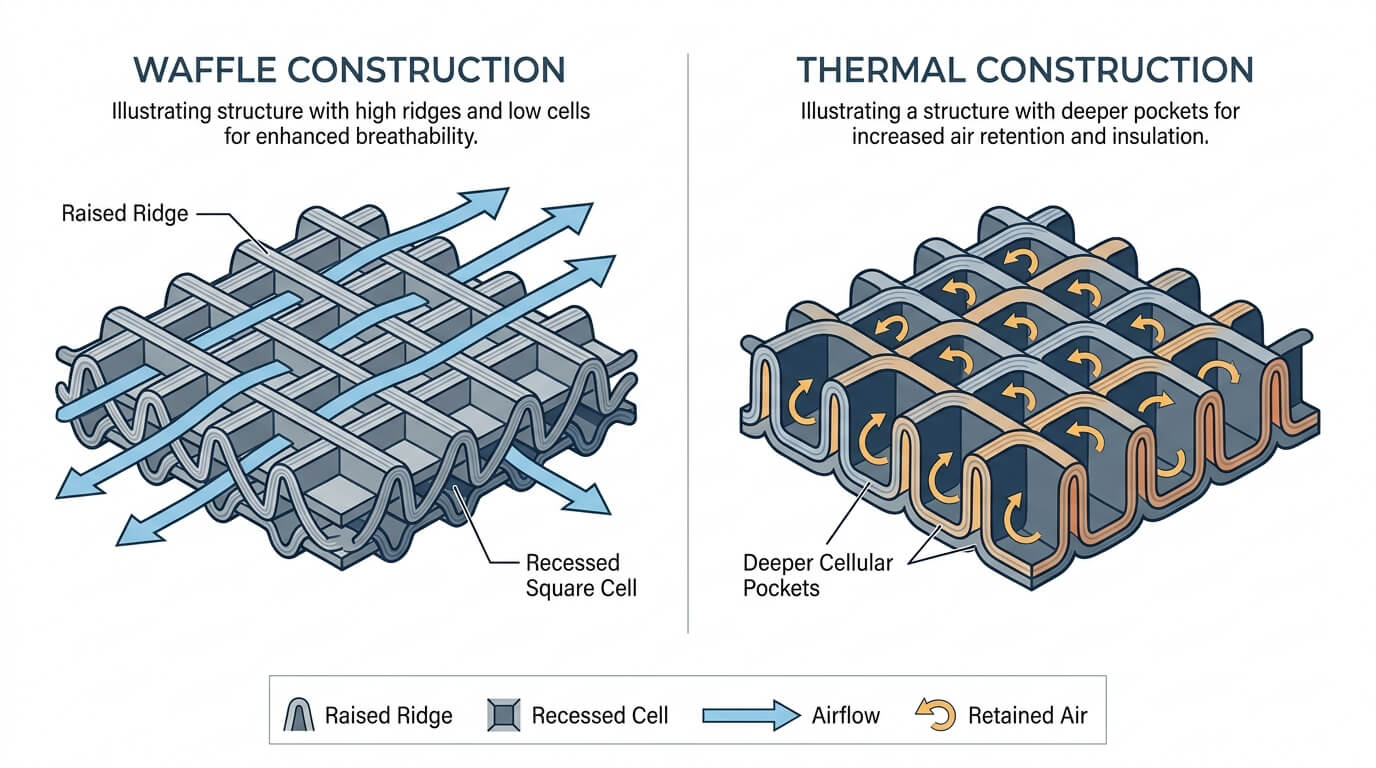
Neither construction is universally better. A cotton waffle blanket may suit a premium hotel or natural homeware collection, while a blended thermal blanket may be more appropriate for frequent institutional laundering and colder conditions.
Quality Testing and Approval Requirements
Develop the test protocol from the product’s end use, destination market, fibre content and care instructions. Relevant evaluations may include:
- Verify materials and weight. Confirm fibre content, GSM, finished piece weight and dimensions.
- Test laundering performance. Measure dimensional stability, appearance and edge performance after the agreed cycles.
- Evaluate the surface. Check pilling, fuzzing, snagging, abrasion and pattern stability.
- Confirm colour performance. Test colourfastness to washing and rubbing using the agreed method and grade.
- Measure functional performance. Consider air permeability and thermal resistance when claims or purchasing criteria depend on them.
- Complete production controls. Include contamination, metal or needle control and pre-production, inline and final inspection.
For products sold in the United States, consult the FTC’s official clothing and textiles guidance. Most textile products require labels stating fibre content, country of origin and the identity of the manufacturer or another responsible business.
Review how Abtex manages blanket quality-control procedures. Destination-market requirements and final artwork should be confirmed before bulk production.
Illustrative Procurement Scenario
A home-textile importer selects a 100% cotton honeycomb construction for boutique hotels and online retail. Development priorities are cell definition, softness, controlled shrinkage, neutral colours, retail-quality hems and premium packing.
The same importer evaluates a cotton-polyester thermal construction for healthcare distributors. Priorities are finished weight, warmth, repeated-wash appearance, pilling resistance, stability, colour identification and compact bulk packing.
This hypothetical example is not a customer case study. Its lesson is straightforward: product selection begins with end use and test requirements, not a photograph or the lowest unit price.
Common Procurement Mistakes
Selecting Only by GSM
A higher GSM product is not automatically warmer, softer or more durable. Construction, thickness, trapped air, fibre, yarn and finishing also matter.
Sending an Image Without a Specification
A photograph cannot establish fibre percentages, yarn count, GSM, dimensions, shrinkage, shade, finishing, testing or packing.
Comparing Non-Equivalent Quotations
One supplier may quote combed cotton with retail packing while another quotes a polyester-rich blend in bulk bales. Comparing unit price alone is misleading.
Skipping Wash Testing
An unused sample can look correct but distort, shrink, pill, lose softness or develop seam problems after laundering.
Ignoring Pattern Stability
Cell dimensions influence appearance, airflow, texture and shrinkage. Approve pattern scale and appearance after washing.
Making Unsupported Claims
Claims such as hypoallergenic, hospital grade, antibacterial, sustainable or certified require evidence and should not be copied from unrelated products.
Leaving Packaging Until the End
Packing affects freight utilisation, carton size, barcodes, presentation, moisture protection and final cost. Approve it with the technical specification.
How to Select a Suitable Blanket Supplier
A capable supplier should translate the application into a controlled manufacturing specification. Evaluate construction capability, accurate fibre and yarn information, GSM and dimensional control, lab-dip development, wash testing, traceability, tolerances, capacity, lead times, export documentation, packing and corrective-action procedures.
Before ordering, request a signed specification, approved sample, test requirements, packing artwork, carton marks, commercial terms, inspection standard and shipment schedule. Explore Abtex’s wider blanket product range and custom blanket manufacturing capabilities.
Conclusion and Key Takeaways
- Choose waffle construction when texture, airflow, natural presentation and decorative bedding appeal are priorities.
- Choose thermal construction when air retention, practical warmth, repeated use and institutional functionality are more important.
- Do not use GSM as the only performance measure.
- Specify fibre percentages, construction, dimensions, tolerances, finishing, testing and packing.
- Approve production only after evaluating the finished sample under intended laundering conditions.
Frequently Asked Questions
Which blanket is better for warm climates?
A waffle construction is generally the better starting point when airflow and a lighter bedding feel are priorities. The final selection should still consider GSM, fibre, cell density and air-permeability performance.
Is a thermal construction always warmer than a waffle construction?
No. Product names do not prove warmth. Thermal resistance depends on fibre, thickness, density, cellular structure, finishing, moisture and the complete assembly.
Is 100% cotton suitable for both constructions?
Yes. Cotton can be used for both. Cotton-rich or polyester-rich blends may be considered for different drying, stability, durability, hand-feel and price requirements.
What information is needed for an accurate quotation?
Provide construction, fibre content, GSM, dimensions, tolerances, colour, finishing, quantity, testing, labelling, packing, destination port and Incoterm.
Should buyers request thermal-resistance testing?
Consider it when warmth is a measurable purchasing requirement or marketing claim. Define the method, conditioning, sample construction and acceptance criteria before production.
Request a Waffle or Thermal Blanket Quotation
Send Abtex your required construction, fibre composition, dimensions, GSM or piece weight, quantity, colours, finishing, testing, labelling, packing, destination and preferred FOB, CFR/CNF or CIF terms.