
How GSM, Yarn Count and Construction Affect a Thermal Blanket
Why equal size and fabric weight do not guarantee equal thickness, texture, airflow, dimensional stability or thermal performance.
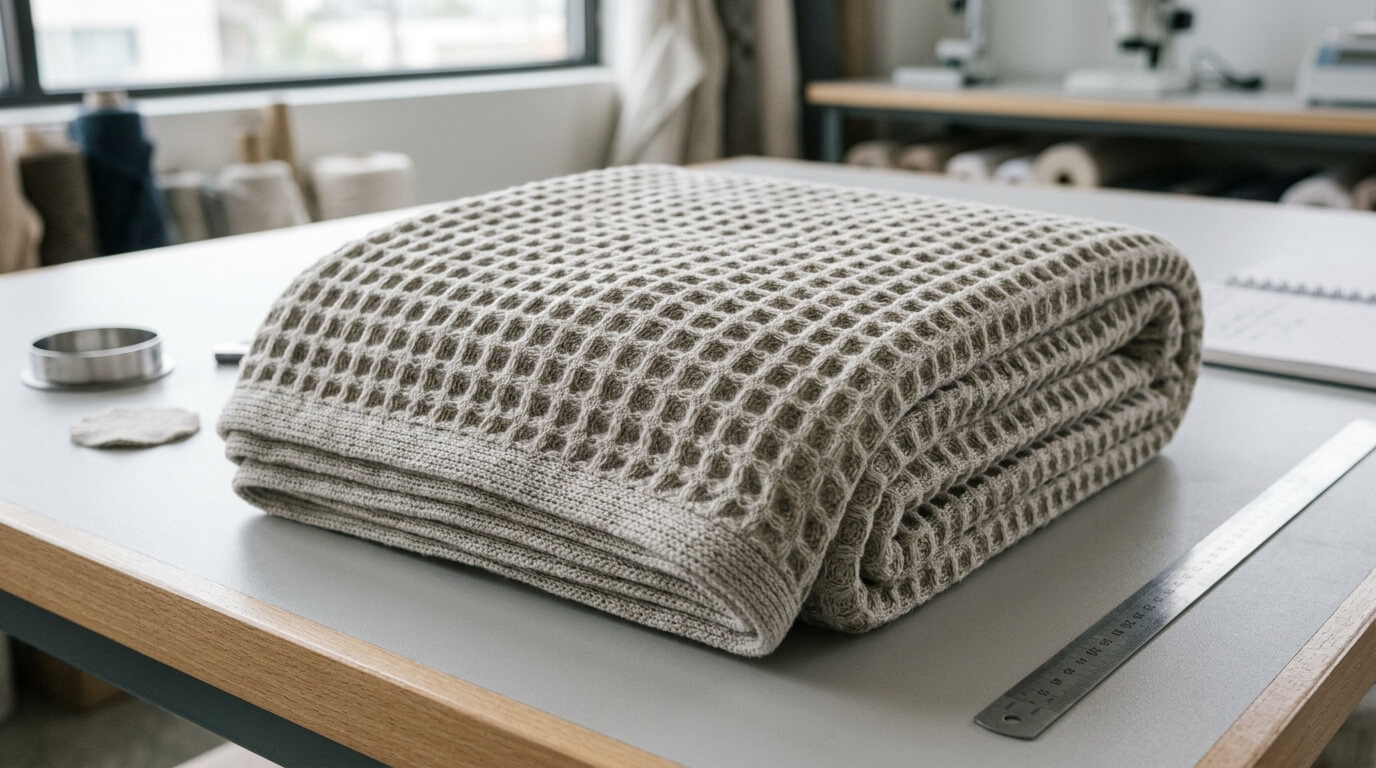
Importers and private-label brands often compare a thermal blanket mainly by size, fibre content and GSM. That approach is incomplete. Two products with the same dimensions and fabric weight can differ significantly in thickness, airflow, surface texture, dimensional stability and thermal performance.
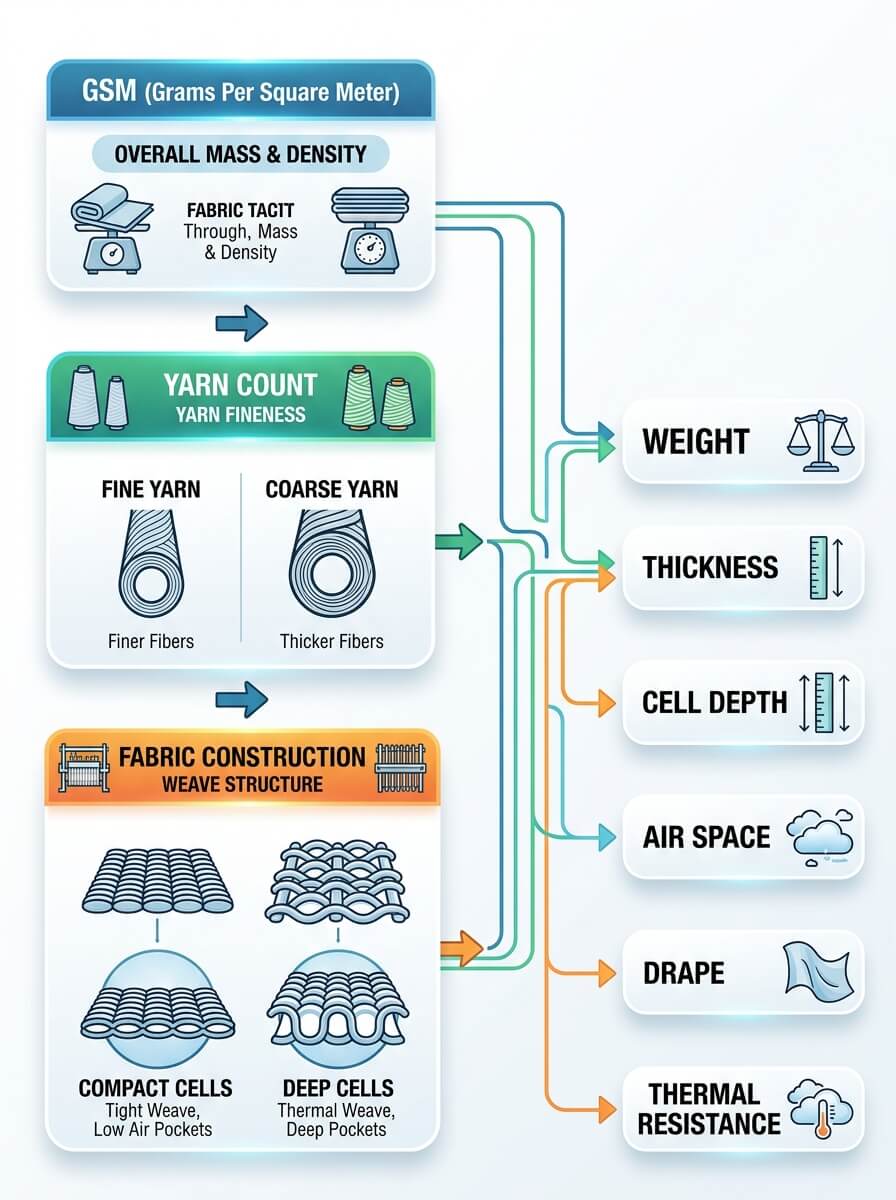
A commercially suitable specification must connect three variables: GSM, yarn count and fabric construction. GSM indicates material mass per square metre. Yarn count describes yarn fineness or linear density. Construction determines how yarns form cells, loops, ridges and air spaces.
Buyers exploring related products can review Abtex International’s blanket manufacturing and sourcing options.
At a Glance: What Determines Thermal Blanket Performance?
Controls fabric mass and influences piece weight, consumption, packing volume, drying demand and perceived substance.
Influences bulk, surface definition, softness, loop or intersection count, strength and how quickly weight builds.
Controls cell geometry, thickness, airflow, drape, stretch and the stationary air held within the textile.
Buyer rule: A higher GSM can support greater warmth, but GSM alone does not prove better insulation. Approve a finished physical sample against measurable specifications.
What Is a Thermal Blanket?
In this guide, “thermal blanket” means a knitted or woven cellular textile covering—sometimes described as waffle, honeycomb or thermal construction. It does not mean a metallised emergency or space blanket.
Raised areas and recessed cells influence thickness, airflow, drape and the amount of stationary air held within the textile. Heat transfer involves conduction through fibres, movement through air spaces and radiation through the structure. Fabric thickness, yarn structure, surface treatment and trapped air therefore contribute to the result.
A flat fabric and a cellular fabric may have the same GSM but behave differently because GSM measures mass per area, not how that mass is distributed. For available development routes, review Abtex’s thermal blanket manufacturing options.
How GSM Affects a Thermal Blanket
GSM means grams per square metre: the mass of fabric covering one square metre. A higher GSM indicates more material per unit area, but does not automatically confirm higher thermal resistance.
What Increasing GSM Can Change
- Finished piece weight and thickness
- Yarn consumption and production cost
- Packing volume and freight efficiency
- Drying time and laundering demand
- Perceived substance and hand feel
What GSM Does Not Define
- Yarn count or ply
- Loop density or cell dimensions
- Finished thickness
- Air permeability
- Thermal resistance
- Wash condition and tolerance
A heavier product may use more yarn, tighter loops, deeper cells or a combination. A dense, compressed construction can contain less insulating air than a bulkier structure at a similar weight. “100% cotton, 400 GSM” is therefore not a complete specification.
Approve GSM after the agreed washing, drying, relaxation and finishing process. A reading taken before these stages may not represent the final commercial article.
How Yarn Count Affects Fabric Weight and Performance
Yarn count describes fineness or linear density. It affects the number of yarns, loops or intersections needed to reach a target GSM and influences bulk, surface definition, softness and durability.
In the English cotton count system, written as Ne, a higher number means a finer yarn. In direct systems such as tex, a higher number means a heavier or coarser yarn; tex expresses the mass in grams of 1,000 metres.
Finer Yarns
- Smaller, more clearly defined cells
- Smoother surface and lighter appearance
- Greater flexibility in density adjustment
- More loops or intersections per area
- May require a denser or more complex structure to reach higher GSM
Coarser Yarns
- Greater visual bulk and prominent ridges
- Deeper cellular texture
- Faster weight build-up
- Heavier and more substantial hand feel
- Not automatically softer or warmer
Single and Plied Yarns
A single yarn is one spun strand; a plied yarn combines two or more strands. Ply can improve balance, appearance and strength but also affects weight, flexibility and cost.
The specification should state yarn count and system, single or plied construction, spinning method where relevant, fibre composition, twist or softness requirement, colour route and colourfastness criteria.
How Fabric Construction Affects Thermal Performance
Construction controls thickness, air spaces, extensibility, airflow and cellular-pattern stability. Thermal resistance is associated with thickness and thermal conductivity rather than mass alone.
Waffle or Honeycomb Construction
Raised ridges surround recessed cells to form a three-dimensional surface. Buyers should define cell size, width and length, ridge height, pattern repeat, face and reverse appearance, openness, border and edge finish. Larger cells may create visual bulk but can increase snagging or distortion risk when too loose.
Compare this structure with Abtex’s cotton waffle blanket constructions.
Knitted Construction
Knitted thermal fabrics use intermeshing loops. Loop length, stitch density, tuck arrangement and machine setting affect weight, thickness and stretch. Longer loops can create openness and flexibility; shorter loops generally create a tighter structure, although excessive tightness may increase stiffness, stress and instability.
Woven Construction
Woven cellular blankets use warp-and-weft interlacement. Floats and grouped interlacings create raised ridges and recessed areas. Woven and knitted constructions differ in stretch, drape, edge stability and shrinkage, so their quotations should not be compared until construction requirements are aligned.
ISO 11092:2026 specifies a guarded-hotplate method for measuring thermal and water-vapour resistance of fabrics and multilayer textile assemblies. The standard notes that its laboratory conditions do not represent every specific comfort situation.
GSM, Yarn Count and Construction Comparison
These are relative sourcing profiles, not fixed industry standards. Compare samples at equal finished dimensions and after the same conditioning process.
| Specification approach | Yarn and construction | Commercial result | Limitations | Suitable applications |
|---|---|---|---|---|
| Lower GSM with finer yarn | Fine yarn, smaller cells and controlled density | Lower weight, compact packing and lighter drape | May provide less substance or thickness | Warm climates, layering and promotional ranges |
| Medium GSM with balanced yarn | Medium count and moderate cell depth | Balanced feel, weight, texture and flexibility | Requires careful consistency control | General retail and year-round home use |
| Higher GSM with coarse yarn | Coarser yarn and deeper cellular structure | Strong texture, bulk and substantial hand feel | Higher consumption, packing volume and drying demand | Cold-season and premium-weight ranges |
| Higher GSM with fine yarn | Fine yarn in a dense structure | Refined appearance and compact surface | May feel dense instead of lofty | Smoothness and definition-led products |
| Blended-fibre construction | Cotton with another specified fibre | Cost, drying and stability can be adjusted | Composition and performance require verification | Institutional, hospitality and value-engineered programmes |
Technical Production and Quality-Control Breakdown
- Define fibre composition. State exact percentages and permitted tolerance; “cotton rich” or “cotton blend” is insufficient.
- Select the yarn specification. Confirm count, ply, spinning method and colour route compatible with the intended construction.
- Develop the construction. Record cell dimensions, loop arrangement, stitch density, repeat and border instead of relying on a photograph.
- Establish unfinished and finished GSM. Calculate expected weight and dimensional change after washing, drying and relaxation.
- Approve washing and finishing. Define dry, softened, pre-washed or mechanically finished hand feel and approve the resulting surface.
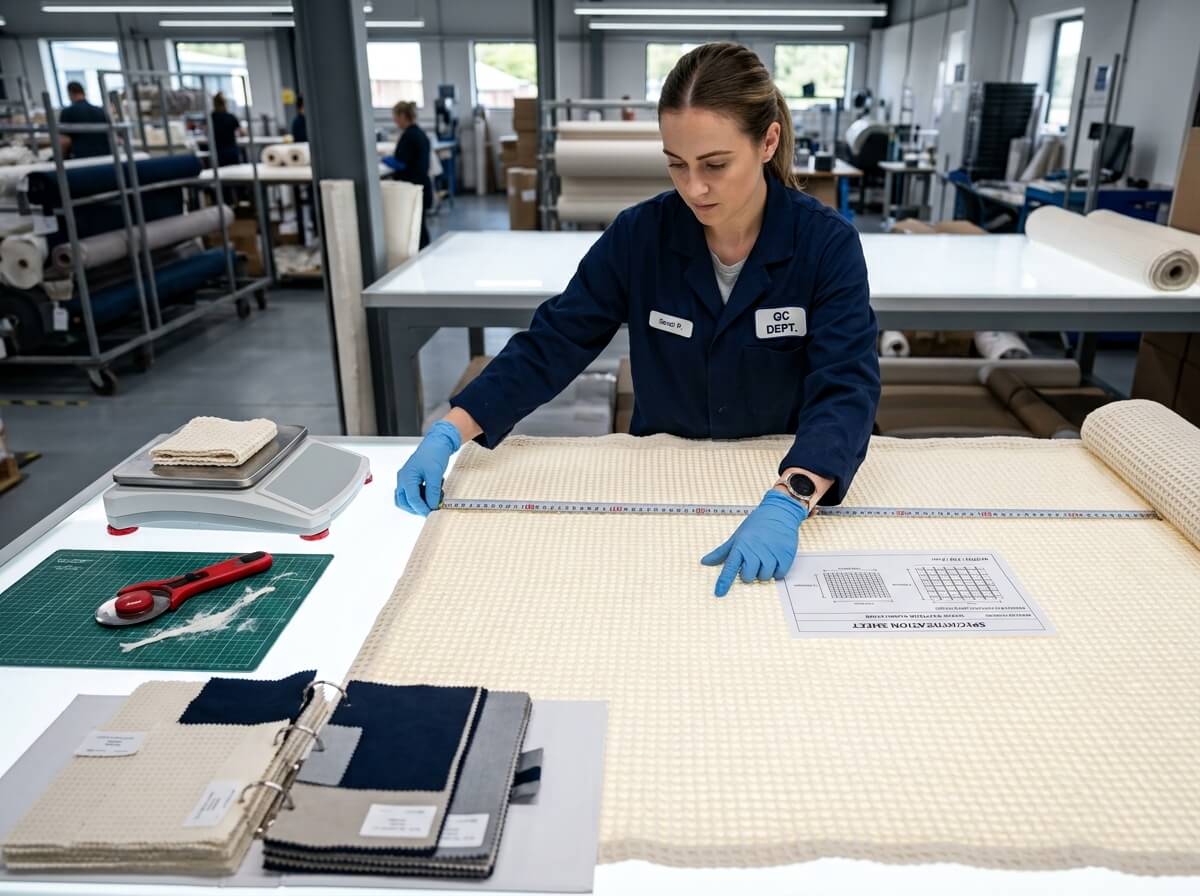
- Test the finished product. Evaluate mass, dimensions, thickness, thermal resistance, airflow, strength, pilling and colourfastness as required.
- Confirm packing and shipment. Approve fold, unit packing, carton dimensions, weight limits and moisture protection.
Where the buyer specifies these methods, ASTM D3776/D3776M covers fabric mass per unit area, AATCC TM135-2025 covers dimensional change after home laundering, and AATCC TM61 provides accelerated colourfastness-to-laundering procedures. The purchase specification should identify the selected method, condition, cycles and acceptance limits.
Review Abtex’s textile quality-control procedures for production-control context.
Buyer Specification and Evaluation Framework
| Product type | Knitted thermal, woven waffle, honeycomb or another defined construction |
|---|---|
| Fibre composition | Exact percentages by weight |
| Finished size | Length and width with tolerance |
| Finished GSM | Target value and permitted tolerance |
| Yarn specification | Count, system, ply and spinning type |
| Construction | Cell size, repeat, density and face/reverse requirement |
| Thickness | Target measurement or approved-sample reference |
| Colour | Shade standard and colourfastness requirement |
| Finish | Softness, washing, relaxation and drying process |
| Performance | Shrinkage, pilling, strength, thermal resistance and other agreed tests |
| Border | Hemmed, knitted-in, bound or another construction |
| Labelling | Fibre, origin, care and private-label information |
| Packaging | Folding, polybag, insert, barcode, carton and pallet requirements |
| Commercial terms | Quantity, sampling, lead time and Incoterm |
Separate mandatory requirements from preferences. Otherwise, suppliers may quote different constructions while appearing to quote the same product. Once these fields are defined, buyers can request a thermal blanket quotation before sample development.
Illustrative Procurement Scenario
A European importer requests a 100% cotton thermal blanket at 350 GSM but initially provides only size, colour and GSM. The supplier explains that the specification is incomplete and develops three alternatives:
Finer yarn with small cells and a controlled compact surface.
Medium yarn with moderate cell depth and density.
Coarser yarn with a larger, more pronounced cellular surface.
All three are developed near 350 GSM, yet differ in thickness, drape, packing volume and appearance. The importer compares washed samples for dimensional change, hand feel, thickness, pilling and thermal resistance before selecting the option aligned with retail positioning.
Commercial lesson: GSM is a useful control point, but yarn, construction, finishing and test results define the approved product.
Common Procurement Mistakes
Selecting Only by GSM
GSM does not describe thickness, cell depth, airflow or yarn quality. Approve a complete construction sheet and physical sample.
Leaving Yarn Count Unspecified
A supplier can use a different yarn to reach the same weight, changing surface definition, cost and performance.
Comparing Non-Equivalent Quotations
Knitted, woven and brushed products should not be compared only by price per piece. Align fibre, size, GSM, construction, finish and packing.
Measuring Before Washing
Measurements can change after relaxation and finishing. Verify dimensions and GSM in the agreed finished condition.
Ignoring Tolerances
A target without acceptance tolerance is not a production specification. Agree limits for weight, size, shade and appearance.
Skipping Performance Testing
A visual sample cannot prove shrinkage, colourfastness, pilling resistance or thermal performance. Select tests for the market and end use.
Using Unsupported Claims
“Extra warm,” “thermal regulating” and “high insulation” require an agreed method and result. Do not convert a GSM figure into an unverified performance claim.
How to Select a Thermal Blanket Supplier
A suitable supplier should explain how the requested weight will be achieved, not simply confirm that a GSM is available. Evaluate yarn and construction details, development samples, finished measurements, shade traceability, testing, bulk tolerances, quality records, private labelling, packing support, planning and Incoterms.
For custom development, review Abtex’s custom blanket manufacturing capabilities.
Destination-market labelling must be confirmed before artwork approval. The US FTC’s textile labelling guidance addresses fibre content, country of origin and responsible-business identification. For Great Britain, consult the official UK textile-labelling guidance, including fibre-content disclosure requirements.
Conclusion and Key Takeaways
- GSM measures mass per unit area, not guaranteed warmth.
- Yarn count affects weight build-up, surface definition and bulk.
- Construction controls yarn distribution and insulating air spaces.
- Measure finished specifications after the agreed washing and finishing process.
- Support performance claims with appropriate testing.
Approve a measurable specification, an agreed finished sample and the required quality tests before releasing bulk production.
Frequently Asked Questions
Does a higher-GSM blanket always provide more warmth?
No. Thermal performance also depends on thickness, construction, trapped air, fibre composition and finishing.
What yarn count should be used for a thermal blanket?
The correct count depends on target GSM and construction. Finer yarn can create smaller cells and a smoother surface, while coarser yarn can create visual bulk and deeper texture.
Why can two blankets with the same GSM feel different?
Different yarn counts, loop densities and cellular structures affect thickness, softness, airflow, drape and surface appearance even when GSM is similar.
Should GSM be checked before or after washing?
Commercial GSM should normally be confirmed in the agreed finished condition because washing, drying and relaxation can change weight distribution and dimensions.
Which tests should a buyer request?
Testing should match the market and end use. Common evaluations include finished weight, dimensions, shrinkage, thickness, colourfastness, pilling, strength and thermal resistance.
Request a Thermal Blanket Specification Review
Send Abtex your required size, composition, target GSM, construction reference, colours, quantity, testing, packing and destination market for a technically comparable quotation.