
Cotton Polyester Carpet Yarn: How Blend Ratio Affects Performance
How cotton-rich, balanced and polyester-rich formulations change strength, abrasion, handle, coverage, shade and loom efficiency.
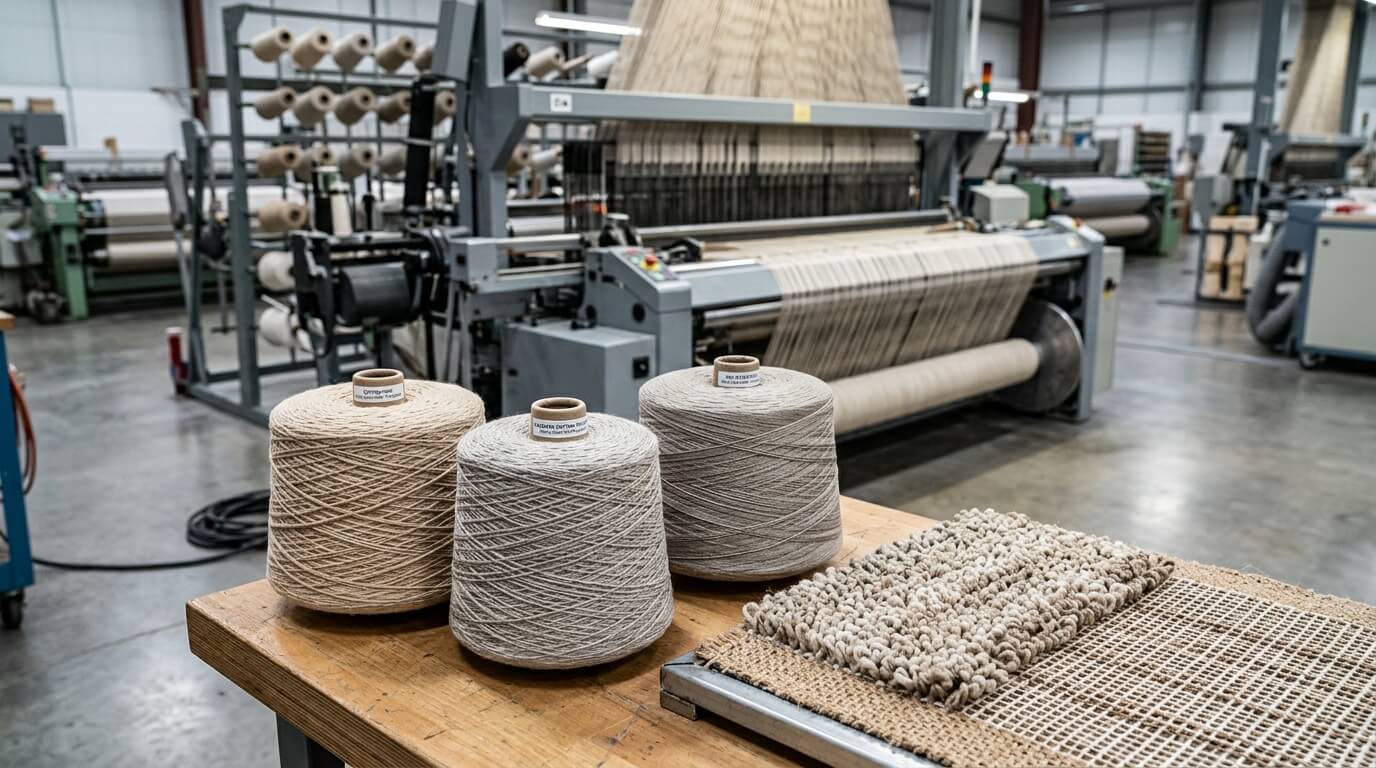
For carpet manufacturers, selecting cotton polyester carpet yarn is not simply a choice between natural and synthetic fibre. Blend ratio can affect strength, abrasion, moisture response, handle, bulk, coverage, dyeing complexity and loom efficiency.
A ratio that works in one rug construction may create lint, poor coverage, shade variation or frequent breaks in another. The decision starts with yarn position: backing, warp, weft and visible decorative yarns face different mechanical and aesthetic demands.
At a Glance: Direct Answer
Cotton contributes absorbency and a softer, more matte surface character; polyester contributes strength, abrasion resistance and dimensional stability. The correct ratio must be validated in the intended carpet construction rather than selected from a generic formula.
Softer handle, greater absorbency and more natural appearance; may increase linting and moisture sensitivity.
A development compromise between handle, strength, absorbency and stability without maximising one property.
Greater durability potential, stability and lower moisture uptake; may create a more synthetic handle and complex dyeing route.
Key controls include yarn position, count, twist, breaking force, tenacity, elongation, hairiness, loom-stop tolerance, coverage, package build, dyeing route and colourfastness.
What Is Cotton Polyester Carpet Yarn?
Cotton polyester carpet yarn is spun by combining cotton and polyester staple fibres in a controlled percentage by mass. In an intimate blend, fibres are mixed before spinning and distributed through the cross-section. This differs from a plied combination, where separate cotton and polyester yarns are twisted together.
Two yarns with the same declared composition can perform differently because fibre distribution, twist, count, spinning method, component structure and evenness differ. Blend ratio is the formulation; yarn construction is the engineering.
Review Abtex’s carpet yarn manufacturing and sourcing solutions and wider yarn product range.
Why Cotton and Polyester Are Blended
- Absorbency and moisture affinity
- Softer, drier surface character
- Fibre-to-fibre friction
- Matte or natural appearance
- Compatibility with cellulosic dye systems
- Strength and abrasion resistance
- Resilience
- Dimensional stability
- Lower moisture absorption
- Potentially improved loom performance
Increasing one fibre does not improve every property. More polyester can improve durability potential while altering handle, bulk and dyeing. More cotton can support softness and absorbency while increasing lint risk under poorly controlled fibre, carding, twist or spinning conditions.
Cotton’s Contribution to Handle and Absorbency
Cotton’s greater moisture affinity changes conditioning, wet processing, dye response, storage behaviour and handle. Cotton-rich yarn may feel softer and less synthetic, show lower lustre and respond well to dyes for cellulosic fibres.
Cotton quality must be specified beyond percentage. Staple length, maturity, strength, cleanliness, colour and lot consistency materially affect running performance. Increasing cotton does not automatically increase bulk; cover also depends on count, fibre fineness, packing, crimp, twist, compressibility and carpet construction.
Polyester’s Contribution to Strength and Stability
Polyester generally contributes strength, abrasion resistance, resilience and dimensional stability. It may suit high or fluctuating loom tension, demanding speeds, guide and reed friction, low moisture sensitivity and dimensional control.
Breaking force must be assessed together with count. A heavier yarn can carry more absolute force because it contains more material; tenacity—force relative to linear density—supports comparison across different counts.
ASTM D2256/D2256M covers single-strand tensile properties including breaking force and elongation, with calculation of breaking tenacity, modulus and toughness. Method, conditioning and acceptance tolerances should be agreed by buyer and supplier.
How the Carpet Yarn Blend Ratio Changes Performance
In the table below, the first percentage is cotton and the second is polyester. These ratios are development categories—not guaranteed performance grades.
| Illustrative blend family | Direction | Main advantages | Main limitations |
|---|---|---|---|
| 70/30 or 65/35 | Cotton-rich | Softer handle, greater absorbency and natural appearance | Potentially more linting, lower wear retention and reduced dimensional stability |
| 50/50 | Balanced | Compromise between handle, strength, absorbency and stability | Does not maximise a single property |
| 35/65 or 20/80 | Polyester-rich | Greater durability potential, stability and lower moisture uptake | More synthetic handle and a different dyeing response |
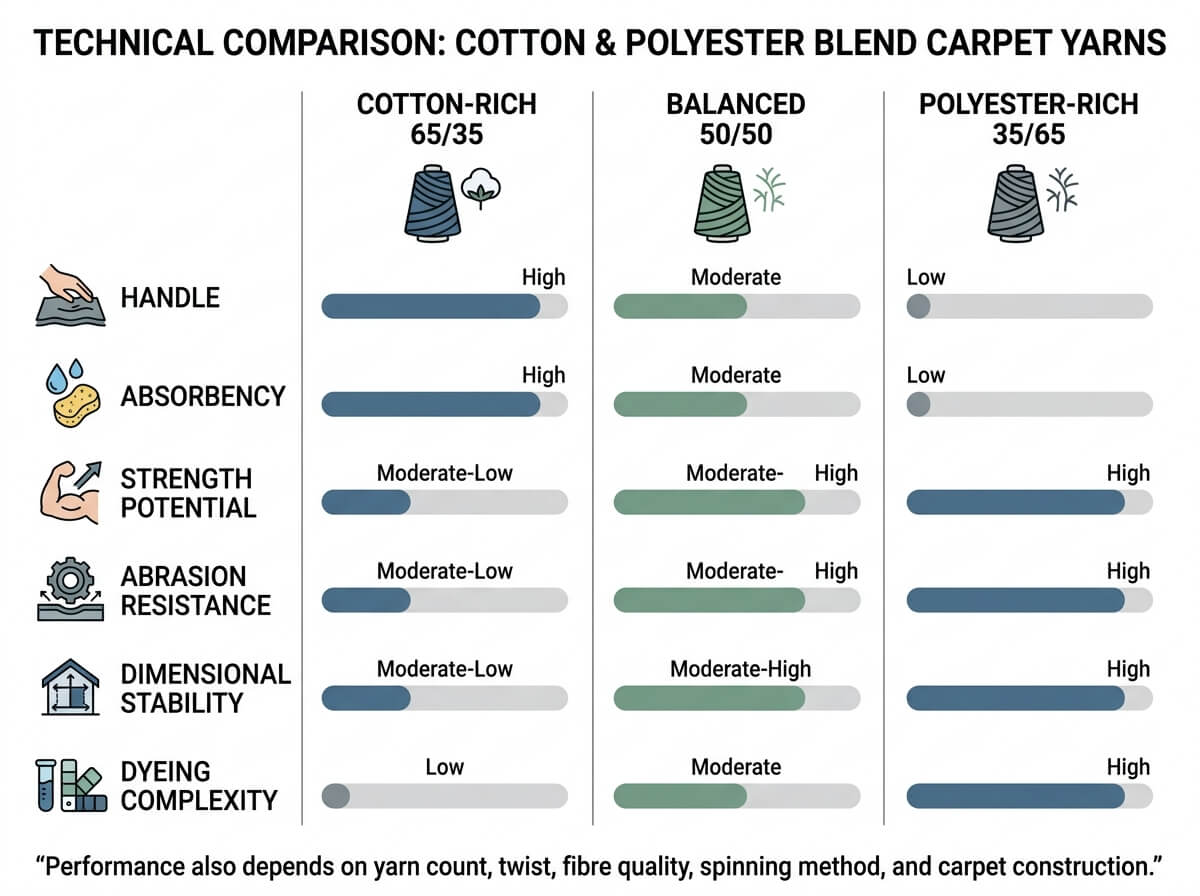
A well-engineered 50/50 yarn can outperform a poorly controlled polyester-rich yarn because fibre quality, twist, count, evenness, blend uniformity and spinning control remain decisive. Use blend families to select trials, not approve bulk without testing.
Abrasion, Bulk, Coverage and Dyeing
Effect on Abrasion Resistance
Increasing polyester generally improves resistance to fibre wear, rubbing and mechanical fatigue, but abrasion is also controlled by twist, direction, hairiness, fibre length, count, ply, spinning system, package hardness, loom speed and guide condition.
Higher twist can improve cohesion and reduce fibre loss; excessive twist can harden yarn, reduce bulk and lower coverage. Finished-carpet abrasion also depends on pick density, backing, coating, finishing and end use.
Effect on Bulk and Surface Coverage
Blend ratio affects bulk through fibre fineness, crimp, compressibility, resilience and packing. At the same nominal count, yarns can have different diameter and coverage. Compare actual count, twist, apparent diameter, compressibility, hairiness, ends or picks, finished backing weight and show-through.
A cone can look bulky but compact under loom tension, processing or coating. Increasing count to correct poor cover raises consumption without necessarily addressing fibre fineness, crimp, twist or density.
Effect on Dyeing and Shade
Cotton and polyester normally use different dye classes and conditions. A uniform blend shade may require controlled union dyeing, separate stages or pre-dyed fibres. Changing ratio changes each fibre’s visible contribution and may alter perceived shade even when both components target the same colour. Buyers requiring custom colour development can also review Abtex’s dyed yarn capabilities.
Define raw white, stock dyed, yarn dyed or solution coloured route; solid, mélange, heather or cross-dyed effect; approved light source; physical colour standard; lot tolerance; fastness and whether backing remains visible. Approve shade on the exact production ratio. Where specified by the buyer, AATCC TM61 provides accelerated colourfastness-to-laundering procedures; the exact condition and required grades should be agreed before production.
Technical Control Points for Blended Carpet Yarn
- Raw-material selectionDefine fibre length, fineness, strength, cleanliness, colour, crimp and source.
- Blend preparationControl weighing, opening and mixing to prevent composition variation, streaks and weak areas.
- Carding and drawingAlign fibres, improve distribution and reduce mass variation before spinning.
- Spinning and twistFix system, count, twist level and direction, ply and production settings. Where bulk, productivity and count range make rotor spinning relevant, review Abtex’s open-end or rotor-spun yarn options.
- Winding and package preparationControl cone size, density, splice quality, contamination, identification and unwinding.
- Laboratory testingCheck composition, count, twist, breaking force, tenacity, elongation, evenness, hairiness, moisture and shade.
- Loom and product validationConfirm unwinding, tension, lint, coverage, finishing, adhesion and appearance.
Review how Abtex manages yarn quality-control procedures.
How to Select a Suitable Blend Ratio
- Define yarn position. State warp, weft, primary or secondary backing, binding, filling or visible decorative use.
- Document the existing construction. Record ratio, count, twist, ply, ends or picks, loom, speed, weight, finishing and current defects.
- Rank performance priorities. Score breakage, abrasion, lint, coverage, handle, absorbency, stability, shade and cost.
- Shortlist two or three ratios. Choose cotton-rich, balanced or polyester-rich directions without testing too many formulations.
- Hold other variables constant. Keep count, twist, ply, package build and loom settings as consistent as practical.
- Compare laboratory results. Review composition, count, twist, force, tenacity, elongation, evenness, hairiness and shade.
- Run a controlled loom trial. Record breaks, tension, lint, unwinding, coverage, stiffness, width, weight, shade and finishing.
- Approve the complete specification. Lock ratio, count, twist, method, ply, package, colour, tests, tolerances and retained sample.
When the trial parameters are defined, buyers can request carpet-yarn trial material or a quotation from Abtex.
Why Loom Trials Are Necessary
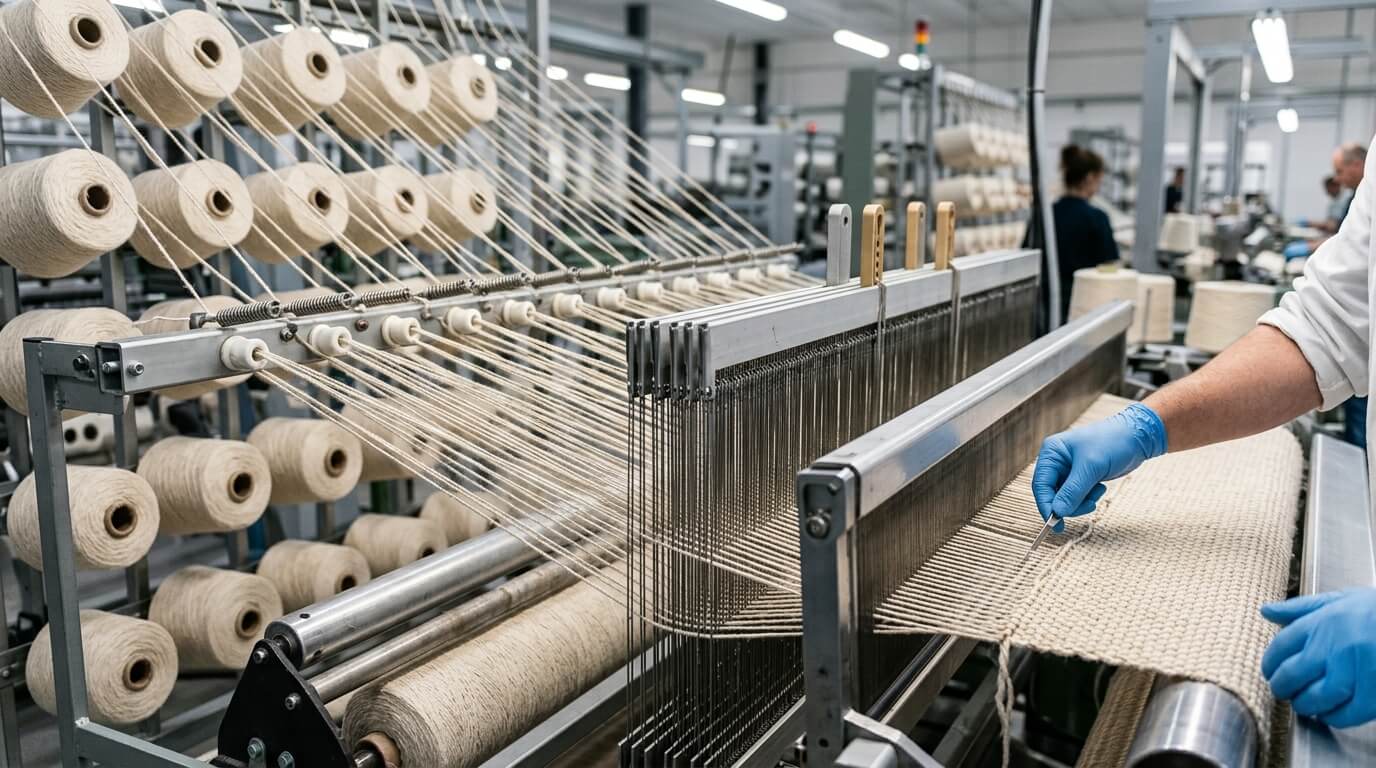
Loom speed, tension, reed condition, pick density, humidity, package build and finishing create interactions that laboratory results cannot completely reproduce. A few metres may prove the loom can start; it does not establish commercial efficiency across normal operating time and full packages.
The approved loom trial and finished construction should become the reference for bulk production.
Illustrative Procurement Scenario
A rug manufacturer using cotton-rich backing yarn experiences lint and intermittent breaks at higher speed. The goal is better strength without an excessively hard or synthetic-looking backing.
Count and twist are held as similar as practical. Laboratory results compare tenacity, elongation, evenness and hairiness, then each option is woven under controlled settings and scored for loom stops, lint, coverage, stiffness, finished weight, shade and finishing.
Commercial lesson: approve the ratio that minimises total manufacturing risk—not the one that merely maximises a single laboratory value.
Common Mistakes and Procurement Risks
Selecting Only by Blend Percentage
Identical composition can perform differently when fibre quality, count, twist, spinning method or evenness changes. Approve a complete specification and retained sample.
Assuming More Polyester Is Always Better
Durability potential may improve while handle, bulk, stiffness, coverage and dyeing become unsuitable. Select for the carpet and loom requirements.
Ignoring Elongation or Comparing Counts by Force Alone
High force without suitable elongation can create problems, while heavier yarn usually carries more absolute force. Review force–elongation behaviour and tenacity.
Approving Colour on a Different Ratio
A recipe may produce a different perceived shade as the fibre ratio changes. Approve colour on the exact production blend.
Changing Several Trial Variables Together
Changing blend, count, twist, tension and pick density simultaneously prevents valid comparison. Change one principal variable at a time.
Ignoring Package Quality or Skipping Loom Approval
Poor cone build and weak splices can cause stops despite acceptable tests. Approve laboratory data, trial cones, loom performance and a retained control sample before bulk.
Supplier Evaluation Checklist
- Fibre declaration and tolerance
- Cotton and polyester material specifications
- Count, twist, ply and spinning method
- Force, tenacity, elongation and evenness data
- Shade and hairiness data
- Consistent cone dimensions and package density
- Trial quantity before bulk
- Lot traceability and retained samples
- Written quality and claim procedures
- Lead time and delivery terms
- Technical support during loom trials
- Clear commercial specification
A quotation listing only price, count and blend percentage is incomplete for technical approval.
Conclusion and Key Takeaways
- Blend ratio changes several properties simultaneously.
- Count, twist, fibre quality and spinning method can be as important as composition.
- Assess strength with tenacity and elongation—not breaking force alone.
- Approve dye and shade on the exact production ratio.
- Complete a controlled loom trial before bulk approval.
Frequently Asked Questions
What is the best cotton polyester carpet yarn blend ratio?
There is no universal best ratio. Cotton-rich, balanced and polyester-rich blends serve different requirements and must be tested for strength, coverage, handle, abrasion, dyeing and loom performance.
Is a 50/50 cotton polyester blend suitable for carpet backing?
It can be a practical starting point, but count, twist, loom settings and backing construction still require validation.
Does increasing polyester always increase yarn strength?
It can improve strength potential, but fibre quality, count, twist, evenness, method and fibre distribution may outweigh nominal percentage.
Does increasing cotton improve yarn bulk?
Not automatically. Bulk and coverage depend on fibre fineness, crimp, diameter, packing, twist, hairiness and carpet construction.
How does blend ratio affect dye shade?
The ratio changes the fibres visible at the surface. Because cotton and polyester use different dye systems and reflect light differently, shade must be developed on the exact blend.
Can different ratios run with the same loom settings?
They may require revised settings because strength, elongation, friction, hairiness and compressibility affect tension, speed, breakage and coverage.
Which yarn tests should manufacturers request?
Request composition, count, twist, breaking force, tenacity, elongation, evenness, hairiness, moisture condition and shade data with agreed methods and tolerances.
Is blended carpet yarn suitable for both warp and weft?
It can serve different positions, but one specification may not suit all. Warp may face higher continuous tension while weft or backing may prioritise coverage and insertion.
Why is a loom trial necessary when laboratory results are available?
It reveals unwinding, tension, breaks, linting, coverage, appearance and finishing behaviour that laboratory tests cannot fully predict.
What information is needed for a quotation?
Provide ratio, count, twist, colour, cone details, quantity, yarn position, loom type and performance targets. An existing sample or data sheet improves development accuracy.
Request a Cotton Polyester Carpet Yarn Trial
Send Abtex the required blend ratio, count, twist, colour, cone specification, quantity, yarn position, loom type, current sample or data sheet and target performance.