
Dyed Cotton Yarn for Sweater Manufacturing
How to specify count, ply, cotton preparation, machine gauge, shade approval, colourfastness and cone quality before bulk knitting.
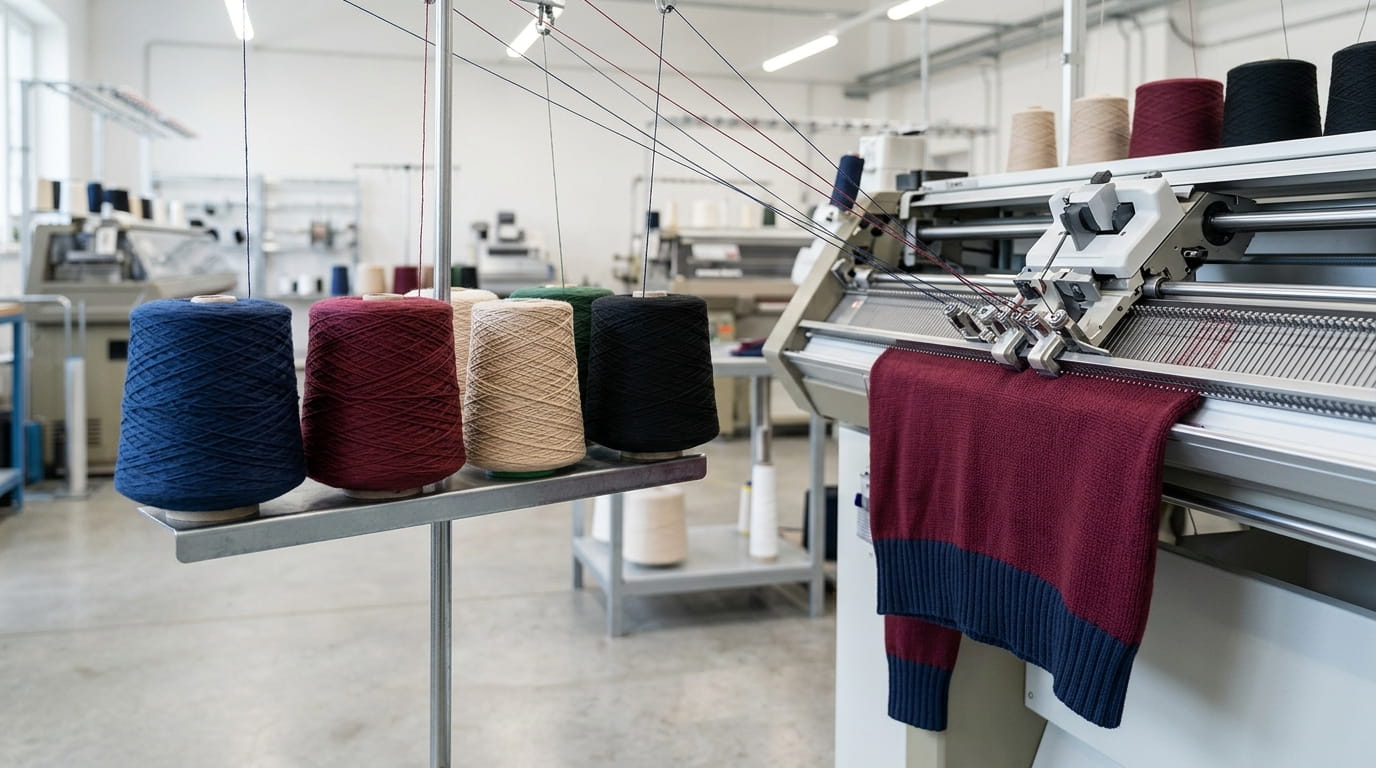
Selecting dyed cotton yarn for sweater manufacturing requires more than choosing a colour and requesting a price. Count, ply, spinning method, twist, shade consistency, package quality, colourfastness and knitting-machine compatibility all affect efficiency and garment quality.
An unsuitable yarn may cause machine stops, uneven panels, barré, visible shade variation, poor dimensional stability or inconsistent garment weight. A commercially acceptable yarn must satisfy both the sweater specification and the operating requirements of the knitting machine.
Manufacturers developing flat-knit programmes can also review the production capability of a specialist flat-knit sweater manufacturer.
At a Glance: What Should Sweater Manufacturers Specify?
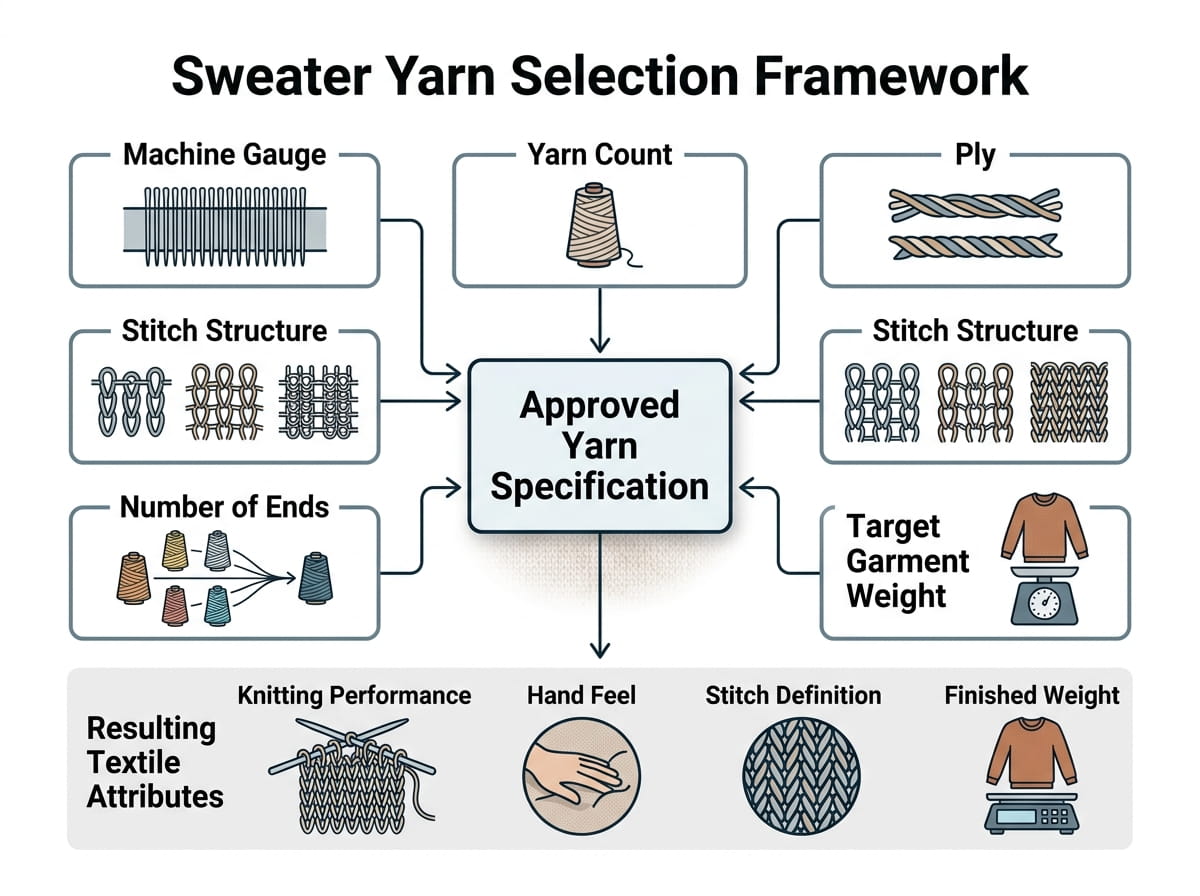
Select yarn according to machine gauge, stitch structure, garment weight, count, ply, colourfastness and target appearance. Machine gauge alone does not establish the correct yarn. Complete a knitting trial on the intended machine before bulk approval.
What Is Dyed Cotton Yarn for Sweater Manufacturing?
Dyed cotton yarn is spun cotton yarn coloured before being knitted into panels or complete garments. It is commonly supplied on cones or packages designed for controlled dye penetration and smooth feeding into flat-bed or V-bed machines.
Yarn dyeing enables stripes, jacquards, engineered colour placement, contrast ribs and multicolour structures without dyeing the completed garment. The trade-off is that dye lots must be controlled carefully because variation becomes visible when garment components are assembled.
Review Abtex’s main dyed cotton yarn range and detailed cone-dyed cotton yarn specifications.
CottonWorks explains that sweater manufacturing primarily uses weft knitting and that flat-bed machine gauges commonly tend to be coarse—approximately 7 to 14 gauge. See its technical overview of sweater manufacturing basics.
How Dyed Cotton Yarn Is Produced for Sweater Knitting
- Cotton and yarn selectionDefine conventional or documented organic cotton, carded or combed preparation, ring-spun construction and single, two-ply or three-ply requirement.
- Yarn count and plyConfirm Ne notation, resultant count, ply twist and the relationship to gauge, stitch and garment weight.
- Dye-package preparationControl package density, tube type, winding tension, carrier loading and liquor circulation.
- Lab-dip and shade approvalDevelop against a recognised colour standard or physical swatch under agreed lighting and instrumental tolerance.
- Dye selectionChoose reactive, direct or vat route according to shade, fastness, end use, care and restricted-substance requirements.
- Drying and rewindingDry, condition and rewind to the cone format approved by the knitting factory.
- Quality control and dispatchVerify composition, count, ply, strength, elongation, evenness, shade, fastness, cone weight and lot identity.
Cotton Preparation, Count and Ply
Carded Cotton
Can provide a fuller, more natural or cost-sensitive appearance. It may show more short-fibre content, hairiness and irregularity than a comparable combed quality.
Combed Cotton
Additional preparation removes more short fibres and impurities, generally supporting a cleaner surface, improved uniformity and clearer stitch definition.
Ne is an indirect count system: a higher number means a finer yarn. Ne 20/2 normally describes two Ne 20 singles twisted together. Confirm notation and resultant count because misunderstanding can change garment weight and machine settings.
Ply yarns are commonly used where additional strength, balance and evenness are required. Abtex’s published sweater range runs from Ne 6/2 to Ne 40/2, with Ne 20/2 and Ne 32/2 commonly supplied. Suitability still depends on gauge, structure, ends and target weight.
Shade Development and Lab-Dip Approval
A lab dip is a small-scale dyeing used to develop and approve colour before bulk production. The buyer supplies a recognised colour reference, electronic spectral data or physical swatch. The dyer develops a formula, dyes and washes the sample, conditions it and compares it with the master standard.
Define the colour standard, light sources, acceptable colour difference, number of submissions, approval authority, bulk tolerance and repeat-order procedure. Office lighting alone is not sufficient for an export colour programme.

Dye Selection and Dark Shades
Reactive dyes are widely used for cotton shades because they can provide a broad range and good wash-fastness potential. Direct dyes may suit selected economical applications, while vat dyes may be considered for demanding fastness requirements. Dark black, navy and saturated shades require controlled washing-off to reduce surface dye and staining risk.
For specialised options, review Abtex’s black-dyed cotton yarn and bleached-white cotton yarn.
Buyer Specifications for Dyed Cotton Sweater Yarn
- CompositionConventional, documented organic or another approved cotton programme
- PreparationCarded or combed
- Count and plyNe count, resultant count, ply and twist
- MachineBrand, model and gauge
- Knitted structureJersey, rib, cable, tuck, jacquard or links
- FeedNumber of ends, stitch length and tension
- Garment targetWeight, hand feel and dimensions
- Shade standardPhysical reference, light source and tolerance
- FastnessMethod, condition and required rating
- PackageCone type, weight, dimensions and winding
- CommercialQuantity by shade, MOQ and lead time
- ShipmentPacking, destination and Incoterm
Once these fields are defined, buyers can request a dyed cotton sweater-yarn quotation before approving sample cones.
Yarn Evenness, Strength and Machine Performance
Unevenness, thick and thin places, neps and excessive hairiness can disturb stitch formation and panel dimensions. The yarn must withstand unwinding, guiding and loop formation without excessive breaks. Evaluate representative cones on the intended machine—not only in the laboratory.
Shade Consistency and Lot Segregation
Yarn for one garment batch should ideally come from the same dye lot. Each carton, cone and packing list should carry a traceable reference, and the factory should maintain continuity between the approved lab dip, bulk lot and retained standard.
Colourfastness Requirements
Specify method, test condition, required grade, care procedure, colour change and staining criteria, and whether testing applies to yarn or the finished sweater.
ISO 105-C06:2010 specifies methods for assessing colourfastness to domestic and commercial laundering. Rubbing or light-fastness requirements may use other agreed ISO 105 methods; always state the precise method and acceptance grade.
Review how Abtex manages yarn quality-control and testing procedures.
Comparison of Cotton Yarn Options for Sweater Production
| Option | Main characteristics | Advantages | Limitations | Suitable use |
|---|---|---|---|---|
| Carded cotton | Contains more short fibres than combed yarn | Fuller appearance and generally economical | May show more hairiness and irregularity | Casual, rustic or price-sensitive sweaters |
| Combed cotton | More short fibres removed | Cleaner surface, uniformity and stitch definition | Higher processing cost | Fine-gauge and cleaner-looking sweaters |
| Single yarn | One spun strand | Softer or casual effect in suitable structures | May be less balanced or robust | Lightweight or deliberately relaxed structures |
| Two-ply yarn | Two singles twisted together | Improved balance, strength and evenness | Additional processing and cost | Flat-knit sweaters, ribs, cables and defined stitches |
| Reactive dyed | Reactive dye bonded to cotton cellulose | Broad shade range and wash-fastness potential | Requires controlled fixation and washing-off | Fashion and commercial cotton sweaters |
| Vat dyed | Specialised vat process | Considered for demanding fastness | Complex processing and colour limitations | Selected uniforms and demanding dark shades |
| Bleached white | Processed to a controlled white | White use or selected downstream processes | Whiteness and yellowing require control | White, optical-white and contrast structures |
Illustrative Procurement Scenario
A sweater manufacturer plans five colours on a 12-gauge V-bed machine. The first enquiry states Ne 20/2 but omits structure, garment weight and fastness.
The supplier develops lab dips under agreed lighting and then supplies cones for the intended machine. One colour needs a tension adjustment; another needs a revised formula before bulk.
Commercial lesson: a precise specification and machine trial reduce the risk of a yarn matching the colour standard but failing in production.
Common Mistakes When Buying Dyed Cotton Sweater Yarn
Selecting Only by Price
A low yarn price can be offset by stops, waste, shade rejection or garment reprocessing. Compare equivalent composition, count, ply, dye class, testing, cone, packing and shipment terms.
Treating Gauge as the Complete Specification
Gauge is one input. Stitch, loop length, number of ends, target weight and hand can change the suitable yarn count.
Approving Colour Without a Measurable Standard
“Navy” or “dark green” is not sufficient. Use an approved physical or spectral reference and controlled light sources.
Skipping Bulk-Lot Approval or Mixing Lots
A successful lab dip does not guarantee bulk reproduction. Assess bulk against the approved standard and segregate lots through knitting, linking and finishing.
Ignoring Cone and Winding Requirements
Incorrect cone dimensions, package density or tension can cause poor unwinding and machine stops. Approve package format before bulk.
Requesting Unsupported Sustainability Claims
Organic, recycled, low-impact or environmentally friendly claims require applicable certification, transaction documents or verifiable evidence.
How to Select a Dyed Cotton Yarn Supplier
- Required composition, count and ply
- Flat-bed knitting knowledge
- Clearly identified carded and combed options
- Lab dips against an approved standard
- Instrumental and visual shade assessment
- Traceable bulk lots and retained standards
- Agreed physical and fastness tests
- Sample cones for machine trials
- Clear MOQ, lead time and shade quantities
- Confirmed cone, packing and pallet format
- Defined Incoterms and shipment duties
- Supported certification claims
Abtex’s main dyed-yarn page presents cone-dyed, black-dyed and bleached-white yarn in carded and combed qualities, including single and plied constructions from Ne 6s to Ne 40s, subject to product type.
Conclusion and Key Takeaways
- Match count and ply to machine, stitch and garment weight.
- Specify carded or combed cotton according to appearance and performance.
- Use controlled lab dips and measurable colour standards.
- Define fastness methods and acceptance grades before production.
- Complete a knitting trial using representative cones.
- Keep dye lots traceable and segregated throughout production.
- Compare quotations using equivalent technical and commercial terms.
Frequently Asked Questions
What yarn count is suitable for cotton sweater manufacturing?
It depends on gauge, stitch, number of ends and garment weight. Ne 20/2 and Ne 32/2 are commonly supplied, but require knitting-trial approval.
Is combed cotton better than carded cotton for sweaters?
Combed cotton generally provides a cleaner, more uniform surface. Carded cotton may suit fuller, natural or cost-sensitive constructions; neither is universally superior.
Why is two-ply cotton yarn commonly used for sweaters?
Two-ply yarn can improve balance, strength, evenness and stitch definition in ribs, cables and structured designs.
Which dyes are used for dyed cotton yarn?
Reactive dyes are widely used for cotton, while direct dyes may suit selected applications and vat dyes may be considered for demanding fastness requirements.
What information is needed for a quotation?
Provide composition, count, ply, gauge, shade reference, quantity per colour, testing, package, destination and Incoterm.
Request Dyed Cotton Sweater Yarn Samples
Send Abtex your cotton composition, carded or combed requirement, count, ply, machine gauge, shade reference, quantity per shade, testing, destination and preferred Incoterm.