
Blend Development Guide
Recycled Wool Blend Guide: Acrylic, Polyester and Nylon for Knitwear
How support fibres influence recycled wool yarn, what each support fibre contributes, and how to choose a blend ratio against your product rather than against a percentage on a label.
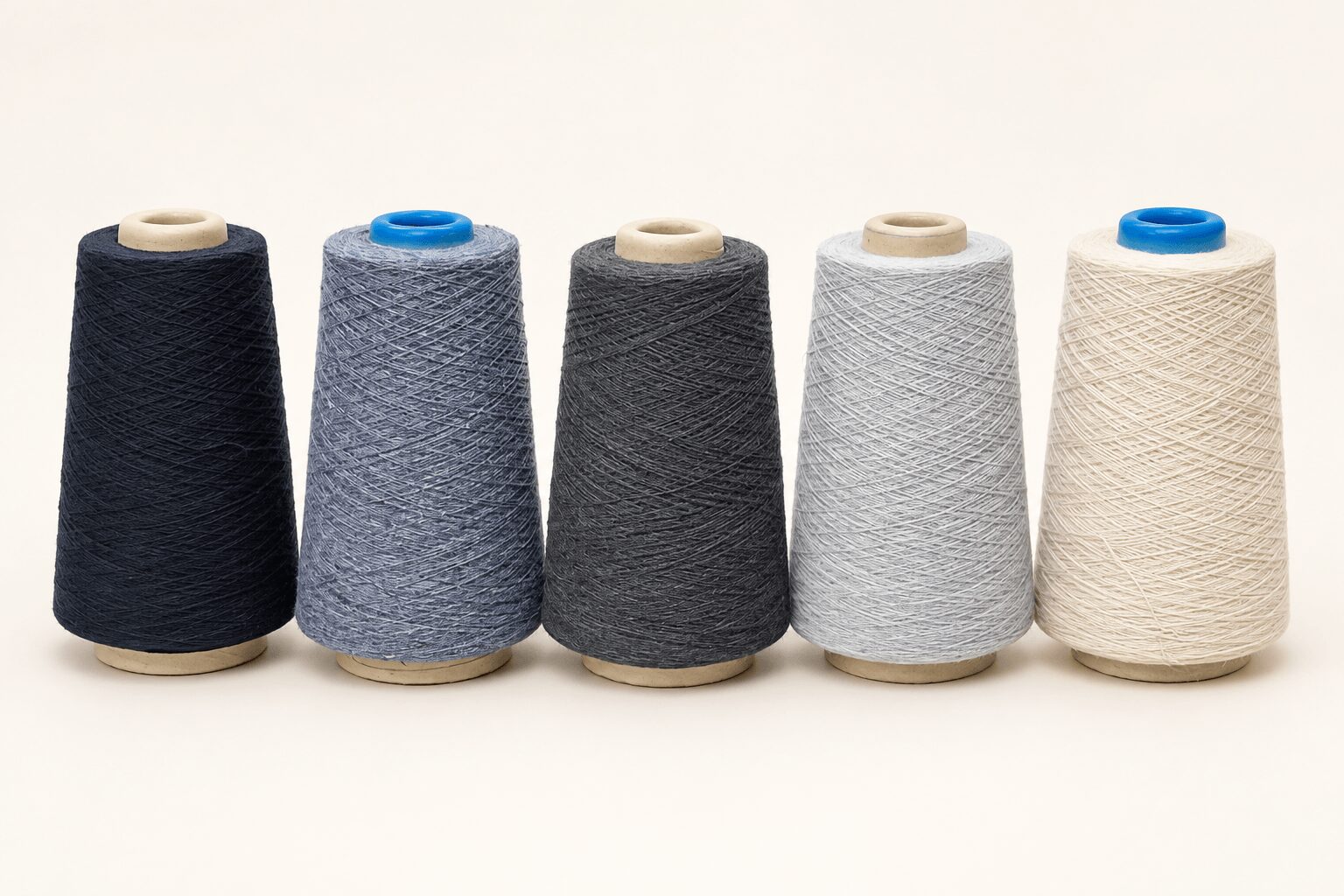
A recycled wool blend is engineered around the limits of mechanically recovered fibre and the performance required in the finished product. Acrylic, polyester and nylon are not interchangeable fillers: each changes strength, abrasion resistance, dimensional stability, bulk and hand. See Abtex International’s recycled wool blend range for the combinations available for development.
“Why isn’t it 100% wool?” is the first question almost every buyer asks about recycled wool yarn, and it usually carries an assumption underneath it — that the synthetic content is a cost-cutting compromise and that a higher wool percentage is automatically a better yarn.
For Abtex’s blended range, support fibres are selected against the application. The highest wool percentage is not automatically the best option; compare finished swatches.
Why a recycled wool blend needs support fibre
A recycled wool blend starts with wool recovered mechanically. Used sweaters are pulled apart on a garnetting machine that tears the knitted structure back into loose fibre. That operation is necessarily violent, and it shortens the fibre.
A wool fibre that entered a garment at 60 mm staple length may come out of the pulling line considerably shorter, and — more importantly — the distribution of lengths widens. You no longer have a controlled staple; you have a population of fibres ranging from usable to too short to contribute anything.
Mechanical recovery can affect fibre length, yarn strength and evenness. Blend development should address the actual recovered fibre and end use. Pure recycled wool products also exist, so poor performance should not be assumed from recycled content alone.
In a recycled wool blend, the support fibre is what makes the yarn manufacturable. It is a scaffold, not a filler.
Recycled wool blend performance: what each support fibre contributes
Acrylic
Acrylic is the most common partner because it is the synthetic that most closely imitates wool’s aesthetic. It is bulky, soft, takes colour well, and adds loft rather than flattening the hand. It contributes moderate strength — less than polyester or nylon — and it is inexpensive.
Acrylic is the default choice where handle and appearance matter most: sweaters, cardigans, scarves, hats, general knitwear.
Polyester
Polyester is stronger and more dimensionally stable than acrylic, with good resistance to stretching and shrinking. It flattens the hand slightly compared to acrylic, and it is the most cost-effective way to add structural integrity to a coarse or heavy construction.
Polyester earns its place in heavier constructions, in blankets and home textiles, and wherever dimensional stability across washing matters more than the last increment of softness.
Nylon (polyamide)
Nylon is commonly selected for abrasion resistance and strength in wool blends. Its effect depends on fibre grade, percentage, spinning and garment construction; confirm wear performance by testing.
Nylon is the fibre of choice for socks, cuffs, welts and anything subject to repeated abrasion.
Recycled wool blend ratios by end use
These recycled wool blend directions are practical starting frameworks for development rather than fixed recipes. For industry context on recovered wool, see the IWTO recycled wool resource.
Actual ratios are confirmed against the specific construction, target price and performance requirement.
| End use | Blend direction | Priority | Notes |
|---|---|---|---|
| Mid-market sweaters | Recycled wool / acrylic | Handle and appearance | Acrylic carries loft and colour; balanced cost position |
| Heavier outerwear knits | Recycled wool / acrylic / polyester | Structure with acceptable hand | Polyester adds stability to a bulky construction |
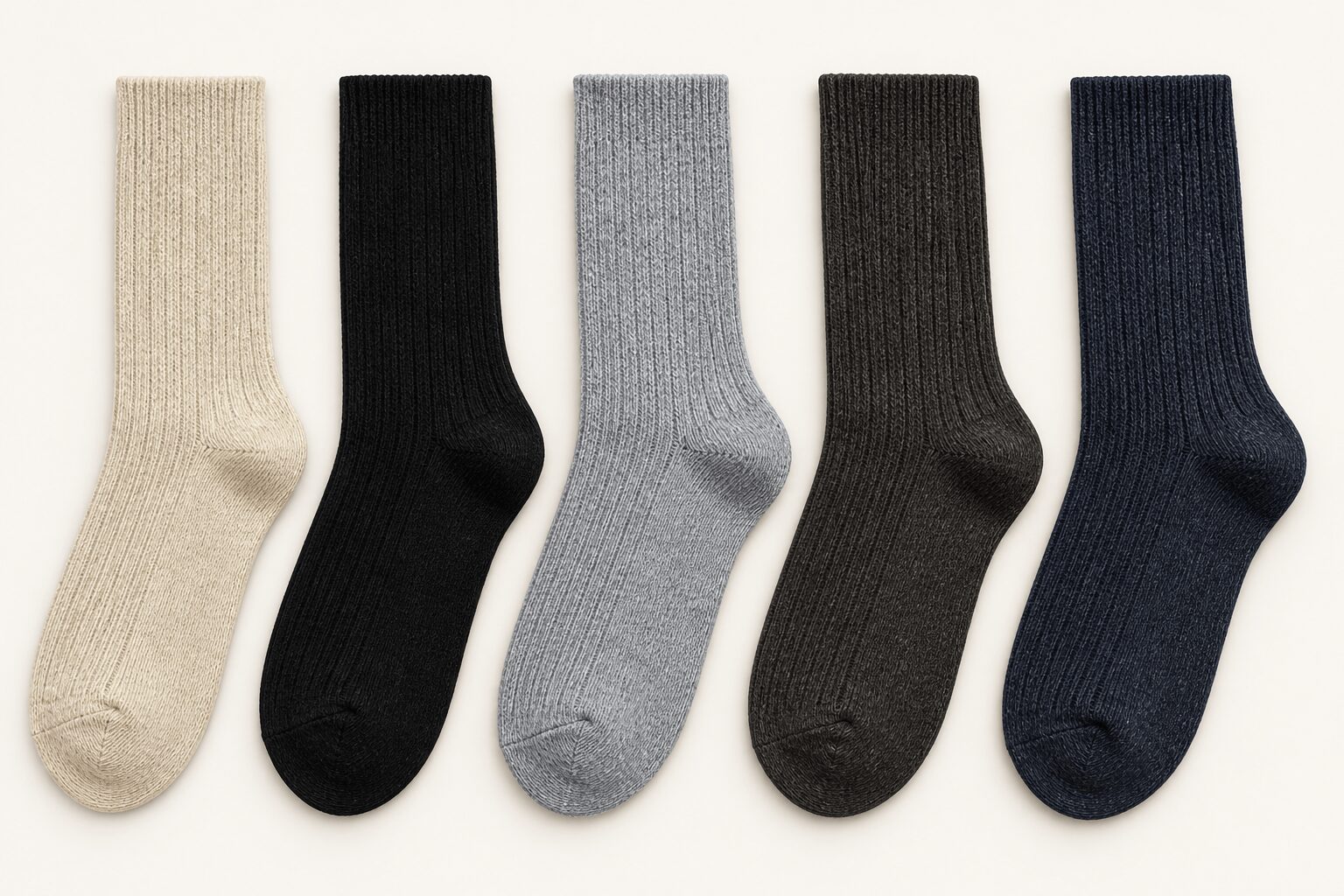
| Socks | Recycled wool / nylon | Abrasion resistance | Confirm abrasion performance on the finished sock |
| Sock with added stability | Recycled wool / polyester / nylon | Wear plus shape retention | Confirm any elastane requirement and how it is introduced |
| Accessories, hats, scarves | Recycled wool / acrylic / nylon | Soft hand with durability | Small nylon content protects high-contact areas |
Where wool percentage actually matters
Wool percentage is not only a performance variable. It is also a labelling and compliance variable, and in some markets that is the constraint that sets it.
Wool content drives thermal performance, moisture management, natural elasticity and the recovery behaviour of the fabric. It also drives price, since recovered wool costs more than commodity acrylic. And it drives what you are permitted to claim on a garment label, which is a separate regulatory question worth resolving early with your compliance team.
Choose wool content against the required handle, performance, price and documented composition. Compare candidate blends on the same finished construction instead of assuming that a higher percentage guarantees better wear.
The trade-offs, stated plainly
- More wool = better thermal and moisture behaviour, better natural recovery, higher price, and generally a higher pilling tendency in recycled blends because the recovered fibre is short.
- More acrylic = softer and loftier hand, better colour, lower cost, weaker tensile performance, and heat sensitivity in pressing and finishing.
- More polyester = better dimensional stability and strength, flatter hand, lowest cost, and reduced breathability.
- More nylon = markedly better abrasion resistance, higher cost than acrylic or polyester, and a slightly harder handle if overdosed.
How to run a blend development properly
- Define the product, not the percentage. Say “a 7-gauge sweater that survives 20 domestic washes without visible pilling,” not “70% wool.”
- State the target landed price per kilogram and the target order quantity. Blend development without a price target is a guessing exercise.
- State any labelling or certification requirement that constrains minimum wool content.
- Develop two or three candidate recycled wool blend options rather than one, and test them side by side.
- Knit swatches on the actual gauge and structure, finish them as bulk will be finished, and wash-test them. Use the count and gauge guide as the starting reference.
- Approve the recycled wool blend on the finished, washed swatch — hand, pilling, shrinkage, shade and weight together — and document the result through the quality control process.
Develop a recycled wool blend with Abtex International
Send the end use, gauge, target count, performance requirement, target price and required wool-content claim. We can review more than one recycled wool blend direction and identify which options should move to swatch testing. start a blend development with our yarn team.
Frequently asked questions
Why is recycled wool blended with acrylic or polyester?
Mechanical recovery shortens the wool fibre and widens the length distribution, which makes 100% recycled wool difficult to spin into an even, strong knitting yarn. Acrylic, polyester or nylon restores tenacity, evenness and spinnability.
What is the best blend ratio for recycled wool yarn?
There is no single best ratio — it depends on the end use. Sweaters typically favour wool/acrylic for handle, socks favour wool/nylon for abrasion resistance, and heavier constructions add polyester for stability. Ratios are confirmed during development against the construction and price target.
Does more wool always mean a better yarn?
No. In recycled blends, a higher wool percentage can increase pilling because the recovered fibre is short. The practical approach is to establish the minimum wool content that meets your performance and labelling requirement, and invest the remainder in support fibre quality and finishing.
How much nylon is needed for sock yarn?
Nylon works disproportionately at low percentages for abrasion resistance, which is why it is standard in sock blends. The exact content should be set against the sock construction, intended wear and price target during development.
Which recycled wool blends does Abtex supply?
Available recycled wool blend combinations include wool/acrylic, wool/acrylic/polyester, wool/nylon, wool/polyester/nylon and wool/acrylic/nylon, in counts from Nm 5/1 to Nm 30/1. Exact ratios are reviewed and confirmed against the buyer’s product requirement.