
Flat Knitting Specification Guide
Yarn Count for Knitting Gauge: Which Wool Yarn Works on 3GG to 14GG?
This yarn count for knitting gauge guide helps flat-knit producers match wool blend yarn counts to 3GG, 5GG, 7GG, 10GG, 12GG and 14GG machines, using the ends-together method, target fabric weight and a proper swatch-approval process before bulk.
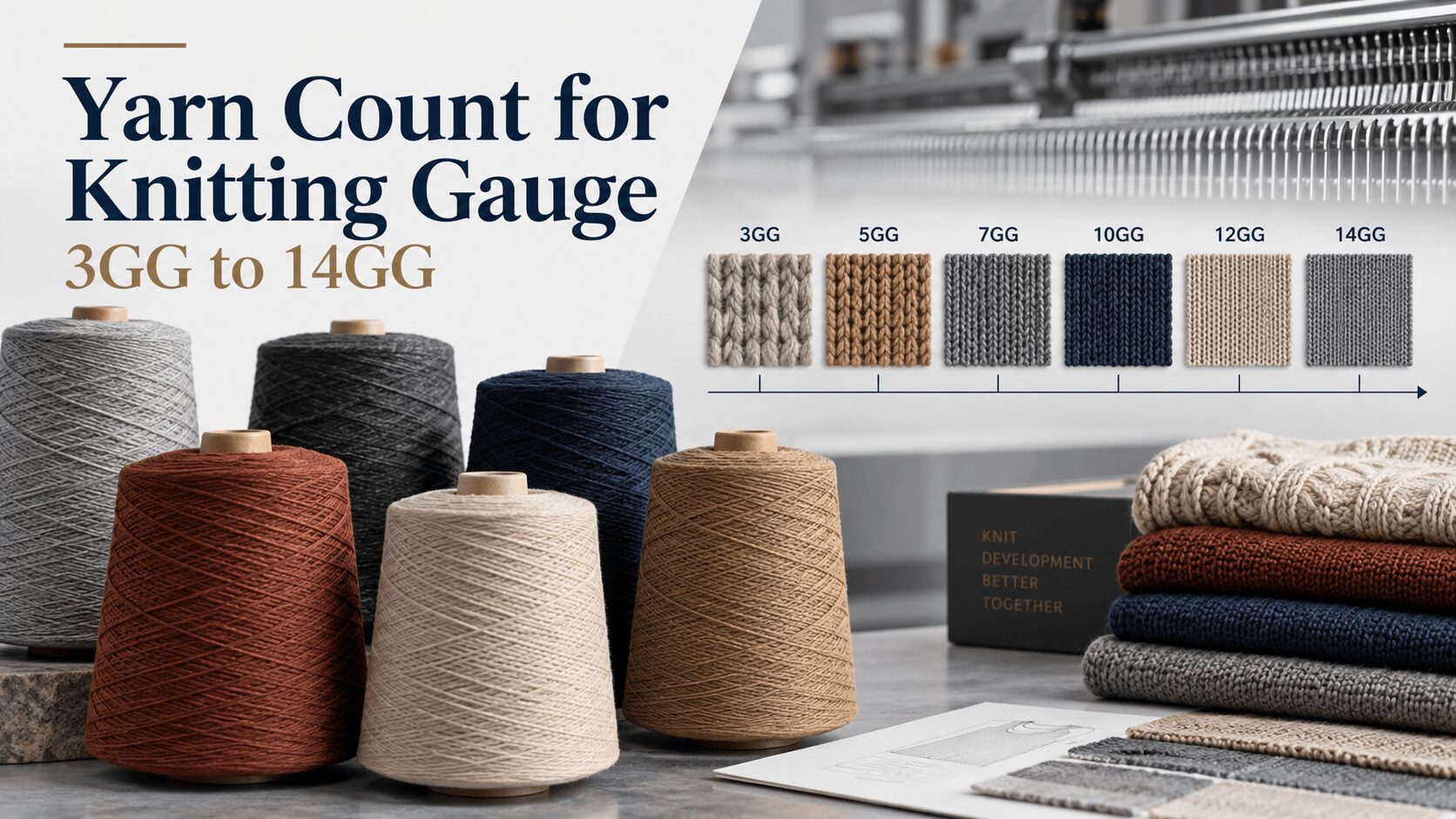
Yarn count for knitting gauge selection should be treated as a development decision, not a fixed chart lookup. The same machine can knit several counts, but fabric density, stitch structure, number of ends and finishing determine whether the result is commercially balanced. For available woollen counts, see Abtex International’s recycled wool blended yarn range.
Gauge and count are two halves of the same decision, and neither can be fixed independently of the other. A 7-gauge machine will physically knit a wide range of counts; what changes is whether the resulting fabric is a dense, boardy panel, a balanced commercial sweater fabric or an open, unstable knit that grows in wear.
This guide gives practical starting points for recycled wool blended yarn, and then explains the method for confirming them, because the starting point is a shortlist, not a specification.
How yarn count for knitting gauge selection works
For yarn count for knitting gauge selection, machine gauge is the number of needles per English inch. A 7GG machine has seven needles per inch; a 12GG machine has twelve. Higher gauge means finer needles, smaller loops and a requirement for finer yarn.
As a rough working rule for yarn count for knitting gauge decisions in flat-knit wool blends, the resultant metric count of the yarn running into the feeder tends to fall somewhere between 1.5 and 2.5 times the gauge number. A 7GG machine therefore commonly runs a resultant Nm 10 to Nm 17; a 12GG machine commonly runs a resultant Nm 18 to Nm 30.
This yarn count for knitting gauge rule is for orientation only. The real answer depends on the stitch structure, the intended fabric weight, the yarn’s bulk, and whether you are running one end or several ends together.
Yarn count for knitting gauge: starting-point table
Application and gauge examples are starting points for sampling, not machine settings or guaranteed compatibility. Confirm yarn construction with the knitter and approve a finished swatch.
| Gauge | Typical resultant Nm | Example construction | Character of fabric |
|---|---|---|---|
| 3GG | Nm 3 – 5 | Nm 5/1 single end, or Nm 10/1 × 2 ends | Chunky outerwear, cardigans, heavy cable |
| 5GG | Nm 5 – 9 | Nm 15/1 × 2 ends, or Nm 8/1 single | Heavy sweaters, winter knitwear |
| 7GG | Nm 10 – 17 | Nm 30/2 (resultant Nm 15), or Nm 15/1 single | Standard commercial sweater weight |
| 10GG | Nm 16 – 24 | Nm 24/1 single end | Lighter sweaters, transitional weight |
| 12GG | Nm 18 – 30 | Nm 28/1 or Nm 30/1 single | Fine knitwear, layering pieces |
| 14GG | Nm 26 – 36 | Nm 30/1 single, fine blends | Very fine gauge; limited in woollen-spun recycled blends |
Note the practical ceiling. Recycled wool blends are woollen-spun from shortened fibre, which sets a limit on how fine the yarn can go while remaining strong and even enough to knit reliably. Above roughly Nm 30 singles, the category becomes difficult, and 14GG work in recycled blends should be development-tested rather than assumed.
For producers specifically asking what yarn count for knitting gauge works on a 7GG machine, the practical commercial starting point is usually resultant Nm 10 to Nm 17. That is why 7GG remains one of the most serviceable sweater gauges for recycled wool blended yarn.
The ends-together method
Running multiple ends into one feeder is standard flat-knit practice and is central to practical yarn count for knitting gauge adjustment. It is the most useful tool you have for hitting a target fabric weight without changing the base yarn you have already approved.
The arithmetic is straightforward. Two identical ends halve the resultant count; three ends divide it by three:
- 1 end of Nm 30 → resultant Nm 30
- 2 ends of Nm 30 → resultant Nm 15
- 3 ends of Nm 30 → resultant Nm 10
- 4 ends of Nm 30 → resultant Nm 7.5
This yarn count for knitting gauge method has a real commercial advantage. Rather than buying four different counts for four fabric weights, you can standardise on one or two base counts and build the range by varying ends. That reduces your minimum order exposure per count, simplifies colour matching across a collection, and keeps stock liquid.
It also has a limit: more ends produce a slightly different surface and hand than a single heavier end of the same resultant count. Marled and heathered effects can be built deliberately this way, but if the range has to look uniform, confirm it on a swatch.
Working back from target fabric weight
Most brands specify a finished garment weight or fabric GSM before they specify a yarn, so yarn count for knitting gauge should be worked backwards from the finished target. Work in this order:
- Fix the target finished fabric weight or garment weight.
- Fix the stitch structure — plain jersey, rib, links-links, cable — since structure changes weight substantially at the same count.
- Select a gauge appropriate to the aesthetic.
- Select the count and number of ends from the table above as a starting shortlist.
- Knit swatches at two or three stitch lengths across the shortlist.
- Wash, finish and condition the swatches exactly as bulk will be finished.
- Measure weight, dimensions, shrinkage and hand on the finished swatches, not the greige ones.
Step 6 is the one most frequently skipped. It is also why yarn count for knitting gauge should never be approved on greige measurements alone. Woollen-spun wool blends relax and bloom significantly in finishing. A greige swatch that measures correctly will not measure correctly after wash, and a specification signed off on greige numbers is a specification that will not hold.
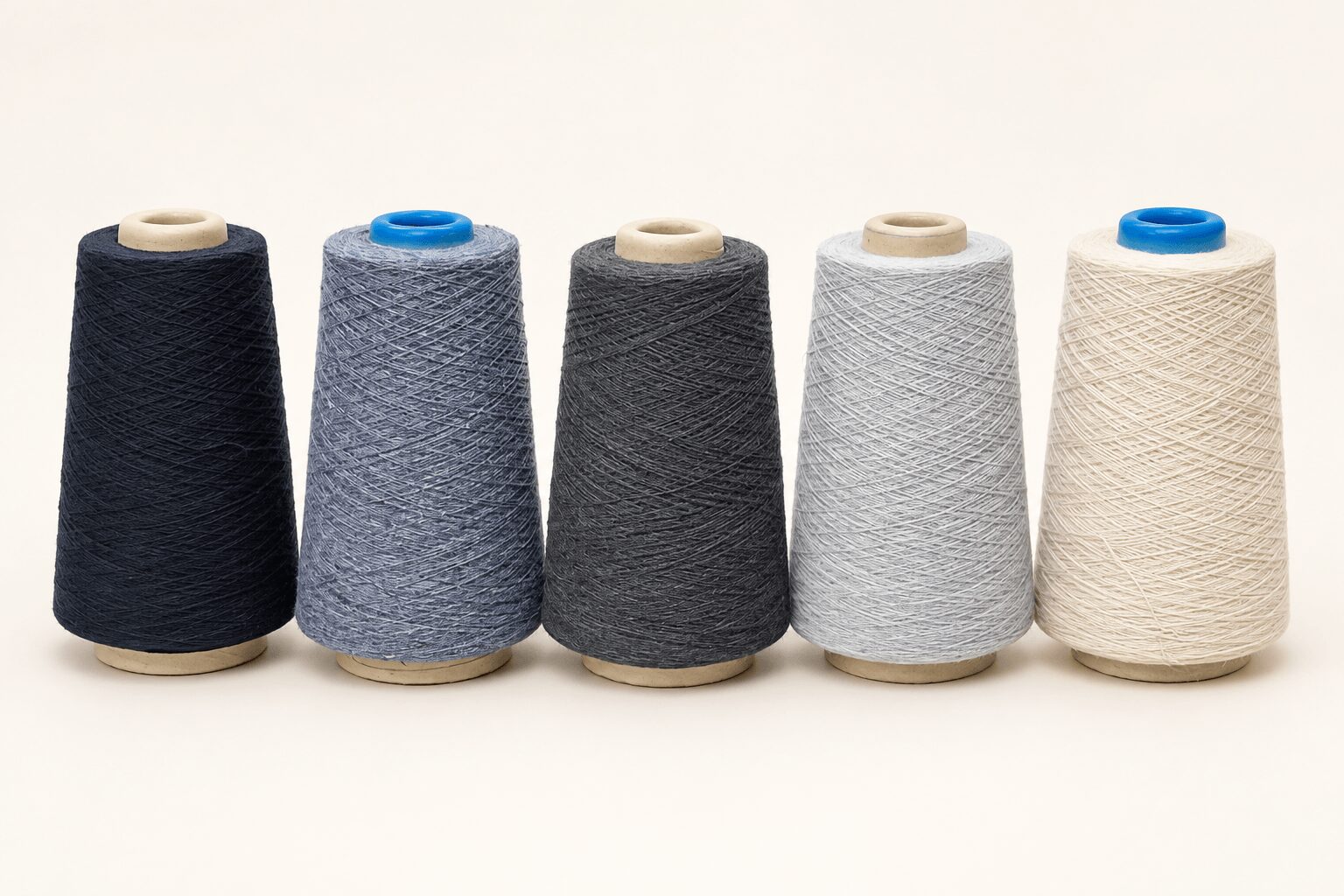
Stitch structure changes everything
At an identical gauge and count, stitch structure moves fabric weight far more than most buyers expect. If count notation is unclear, use the Nm, Ne and Tex conversion guide. For formal linear-density terminology, see ISO 1144:2016.
- Plain jersey — lightest for a given count; curls at the edges, needs trims.
- 1×1 and 2×2 rib — substantially heavier per unit area and narrower; excellent recovery.
- Links-links / garter — heavier again, stable, with a flat non-curling edge.
- Cable and aran — heaviest, and consumption per garment rises sharply; budget yarn accordingly.
If you are costing a cable-knit garment on jersey consumption figures, the costing will be wrong before the first swatch is knitted.
Practical notes for recycled wool blends specifically
- Allow more relaxation. Woollen-spun blends bloom in finishing. Build that into the panel dimensions.
- Check pilling on the actual structure. Blend ratio and gauge both influence it; a jersey result does not predict a rib result.
- Approve shade across lots. Recycled fibre carries wider lot-to-lot shade variation than dyed virgin yarn. Agree a shade band up front.
- Order swatch yarn from the production blend, not a similar cone from stock, or the swatch approval means nothing. Review how recycled wool yarn is made when setting expectations.
Confirm yarn count for knitting gauge before bulk
Send the machine gauge, stitch structure, target fabric or garment weight, preferred composition and available base counts. Abtex International can use that information to shortlist the yarn count for knitting gauge combination that should be swatched before bulk approval. For 7GG and 12GG flat-knit developments, request a development sample and share the gauge, structure, target weight and required blend.
Frequently asked questions
What yarn count is used for a 7GG knitting machine?
For yarn count for knitting gauge on 7GG, most commercial sweater work runs a resultant metric count of roughly Nm 10 to Nm 17 — for example Nm 30/2 giving a resultant Nm 15, or a single end of Nm 15/1. The exact count depends on stitch structure and target fabric weight, and should be confirmed by swatch.
What yarn count is used for 12GG knitting?
For yarn count for knitting gauge on 12GG, typically use a resultant Nm 18 to Nm 30 — often a single end of Nm 28/1 or Nm 30/1 in a wool blend. Finer than this becomes difficult in woollen-spun recycled blends.
How do I calculate the resultant count when running multiple ends?
Divide the singles metric count by the number of ends. Two ends of Nm 30 give a resultant Nm 15; three ends give a resultant Nm 10.
Can recycled wool blends be knitted at fine gauges like 14GG?
It is possible but constrained. Recycled wool is woollen-spun from shortened fibre, which limits how fine the yarn can be spun while remaining even and strong. Fine-gauge work in recycled blends should be development-tested before it is committed to a range.
Should I approve a swatch before or after finishing?
After. Woollen-spun wool blends relax and bloom considerably in finishing, so greige measurements do not predict finished measurements. Approve weight, dimensions and hand on a swatch finished exactly as bulk will be.