
Cotton vs Cotton-Polyester Thermal Blankets: What Changes in Performance?
How fibre composition changes touch, moisture response, drying, stability and commercial positioning—and which performance variables remain controlled by construction.
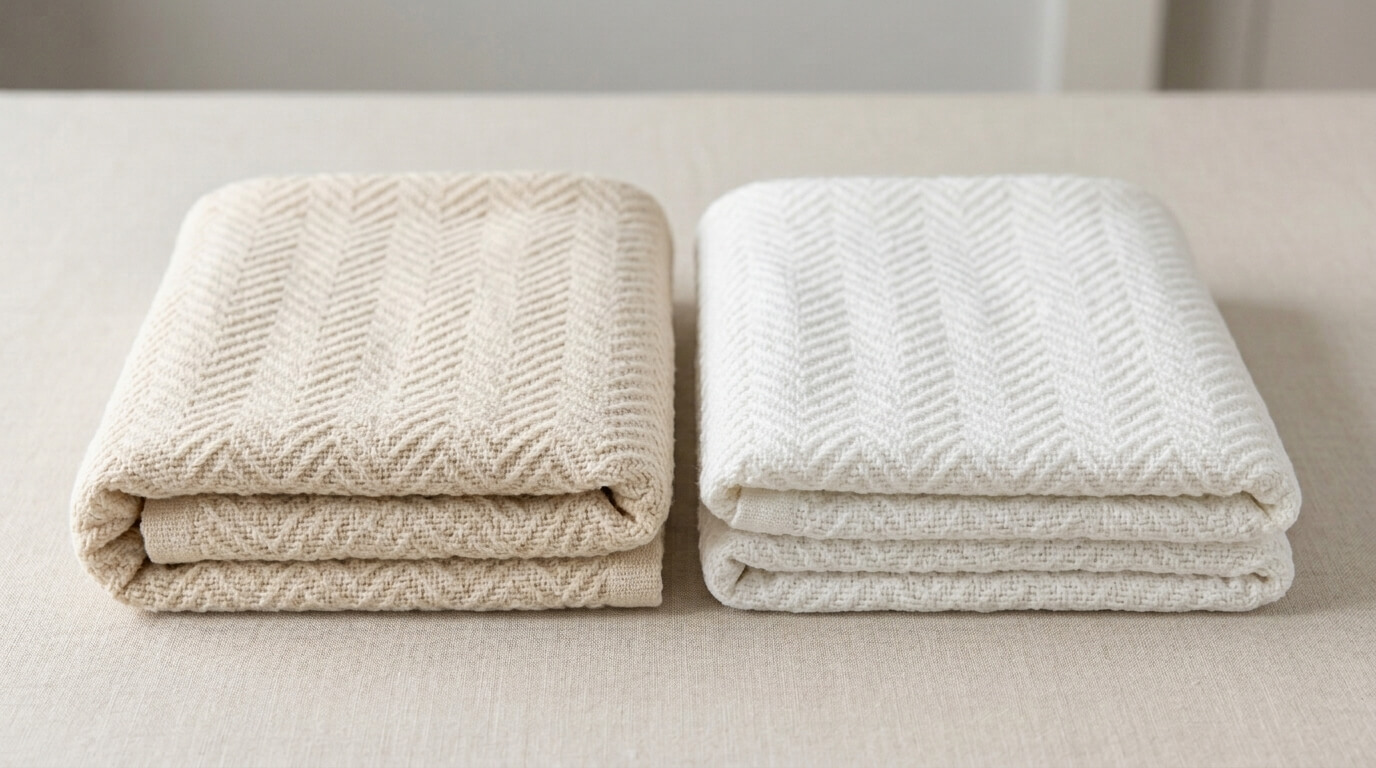
Fibre composition is one of the first specifications buyers notice when developing a thermal blanket, but it does not work in isolation. A 100% cotton blanket and a cotton-polyester blanket can differ in hand feel, moisture response, drying time, dimensional stability, durability and commercial positioning.
Warmth also depends heavily on GSM, yarn size, fabric structure, finishing and the amount of air held within the construction. The correct choice is the composition that supports the intended use, care conditions, target price and performance standard.
Generally offers a more natural hand, greater moisture absorption and a breathable, cotton-led product story.
Generally dries faster, resists dimensional change more effectively and may support repeated-use durability.
Neither option is automatically warmer or better. Compare composition together with GSM, thickness, construction, finishing, shrinkage, pilling and colourfastness.
What Does Fibre Composition Change?
Cotton is a cellulosic fibre that absorbs substantially more moisture than polyester. Polyester has very low moisture regain, so it retains less water within the fibre and normally dries faster. A blended yarn combines these behaviours according to fibre percentages and blanket engineering.
The ratio is not a minor labelling detail. A cotton-rich blend normally remains closer to cotton in touch and moisture behaviour, while a polyester-rich blend moves further toward quick drying, shape retention and synthetic hand characteristics.
For the United States, most covered textiles must accurately disclose fibre content, country of origin and the responsible manufacturer or dealer. Review the FTC’s official textile labelling guidance.
Performance Comparison
| Performance area | 100% cotton | Cotton-polyester |
|---|---|---|
| Hand feel | Natural and familiar | Can feel smoother or firmer |
| Moisture absorption | Higher | Lower as polyester increases |
| Drying | Usually slower when wet | Usually faster |
| Dimensional stability | Requires careful finishing control | Polyester can improve shape retention |
| Durability | Depends on yarn and construction | Often selected for repeated-use programmes |
| Breathability | Commonly associated with breathable comfort | Depends strongly on construction |
| Product positioning | Natural-fibre and comfort-led | Easy-care, value or institutional |
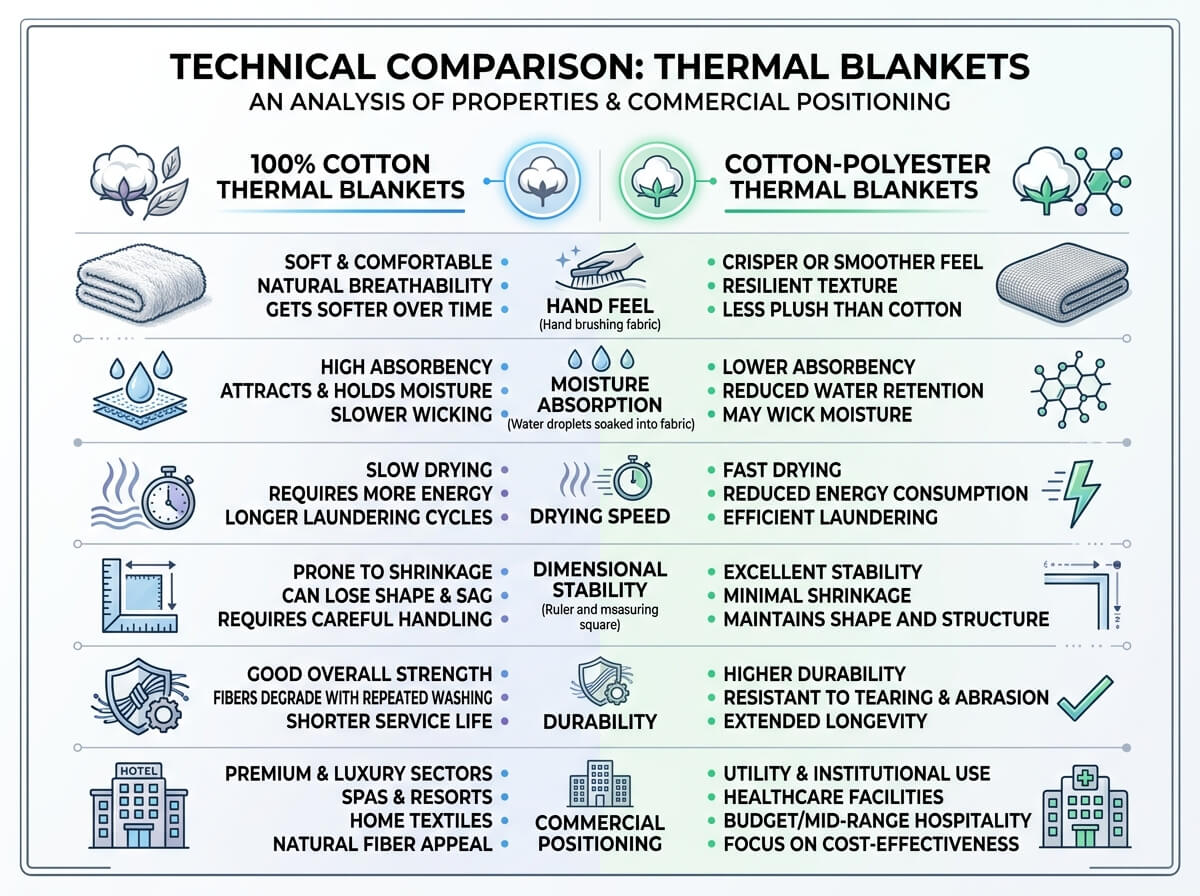
These comparisons summarise fibre moisture behaviour, blended-textile performance and dimensional stability. The finished result still depends on the complete blanket specification.
Comfort, Touch and Moisture Response
Cotton absorbs water into the fibre, supporting a natural feel and handling small amounts of moisture. When heavily wet, retained water increases drying time and may leave the product damp longer.
Polyester absorbs very little moisture within the fibre. In a cotton-polyester construction, this usually reduces total water retention and supports faster drying—important in hotels, institutional laundries and rental programmes where turnaround time matters.
A blend should not automatically be marketed as “moisture-wicking.” Wicking depends on yarn geometry, capillary pathways, fabric structure and finishing—not merely polyester content.
Does Polyester Make a Thermal Blanket Warmer?
Not necessarily. Fibre composition influences heat and moisture transfer, but warmth depends strongly on GSM, thickness, cell or loop geometry, fabric density and trapped air. Two blankets with the same composition can perform differently when their constructions differ.
Dry and wet conditions may also change measured thermal behaviour. Compare cotton and blends with GSM, dimensions, construction and test conditions held as constant as possible. Test thermal resistance, air permeability and moisture response when performance claims are commercially important.
More mass does not alone establish warmth or comfort.
Cell geometry, density and thickness affect trapped air.
Wet and dry textile behaviour may differ significantly.
Washing, Shrinkage and Dimensional Stability
Cotton constructions can relax and change dimensions during laundering, particularly when yarn, loop length, mechanical tension and finishing are not controlled. Polyester generally contributes greater dimensional stability, so adding it can help a blanket retain size and shape through repeated care cycles.
This does not mean blended blankets do not shrink. Test every finished blanket under the agreed washing and drying procedure.
ISO 6330:2021 specifies domestic washing and drying procedures for textile testing. The specification should identify machine type, temperature, detergent, drying method and cycle count because different parameters can produce different results.
Where AATCC methods are required, AATCC TM135-2025 covers dimensional changes of fabrics after home laundering. Buyers should state the selected laundering procedure, number of cycles and acceptance tolerance.
Measure shrinkage in length and width. Also inspect edge distortion, skew, seam performance and overall shape retention rather than relying on one percentage.
Durability, Pilling and Appearance
A cotton-polyester blend is often chosen where repeated laundering and operating life are priorities. Polyester can help maintain shape and appearance, making blends relevant for frequently washed programmes.
Pilling cannot be predicted from fibre content alone. Staple length, twist, hairiness, abrasion, finishing and laundering all matter. Strong synthetic fibres may hold pills on the surface once they form, so a blended specification still needs an agreed pilling method and grade.
Colour performance depends on dye system and process control. Cotton and polyester require different dye classes, so blends need controlled dyeing to achieve shade consistency and acceptable colourfastness.
AATCC TM61 provides accelerated procedures for evaluating colourfastness to laundering. The purchase specification should identify the exact test condition and required colour-change and staining grades.
Commercial and Product-Positioning Differences
A 100% cotton version is easier to position around natural material, tactile comfort and cotton-focused merchandising. It may suit home retail, lifestyle brands or hospitality collections where cotton content is central.
A cotton-polyester blanket may suit price-sensitive programmes, frequent-laundry applications and buyers seeking a balance between cotton comfort and easier care.
Cost is not determined by composition alone. Fibre prices, ratio, yarn system, GSM, dyeing, finishing, quantity, packing and testing all affect the quotation.
Abtex develops both options for custom programmes. Review its thermal blanket manufacturing options, compare cotton waffle blankets, explore custom blanket manufacturing, or review its blanket quality-control procedures. Buyers can also browse the wider blanket range.
What Should the Product Specification Control?
- Exact fibre percentages
- Yarn count, type and spinning system
- Finished GSM and test method
- Finished dimensions and tolerance
- Construction and edge finish
- Washing and drying procedure
- Maximum shrinkage after agreed cycles
- Pilling, colourfastness and appearance
- Packing, labelling and market compliance
ASTM D3776/D3776M-20(2025) covers measurement of fabric mass per unit area and includes different options for full pieces, full-width samples, small swatches and narrow fabrics. State the selected method and conditioning basis in the specification.
Conclusion
The main difference is not simply whether one option is better. A 100% cotton blanket emphasises natural touch, absorbency and cotton-led positioning. A blended version can improve drying speed, dimensional stability and repeated-use performance.
The decision should reflect the customer, laundering conditions, required service life, price and approved tests. Composition must then be evaluated with GSM, construction, finishing and tolerances.
Frequently Asked Questions
Is a cotton-polyester thermal blanket warmer than cotton?
Not automatically. Warmth depends heavily on GSM, thickness, construction and trapped air, so both products must be compared under similar conditions.
Which thermal blanket dries faster?
A blended version generally dries faster because polyester absorbs much less moisture within the fibre. Actual time still depends on GSM, construction and drying conditions.
Does a cotton-polyester blanket shrink?
Yes, it can. Polyester may improve dimensional stability, but the finished blanket must still be tested after the agreed washing and drying cycles.
Is 100% cotton always the premium option?
No. Cotton supports natural and comfort-led positioning, but premium quality also depends on yarn, construction, finishing, testing and workmanship.
What information is needed for a quotation?
Provide composition, size, GSM, construction, colour, quantity, testing, packaging and destination. A reference sample or technical image can reduce development ambiguity.
Send your composition, size, GSM, construction, colours, quantity, testing, packaging and destination for a technically comparable quotation, or request a blanket quotation through the Contact page.