
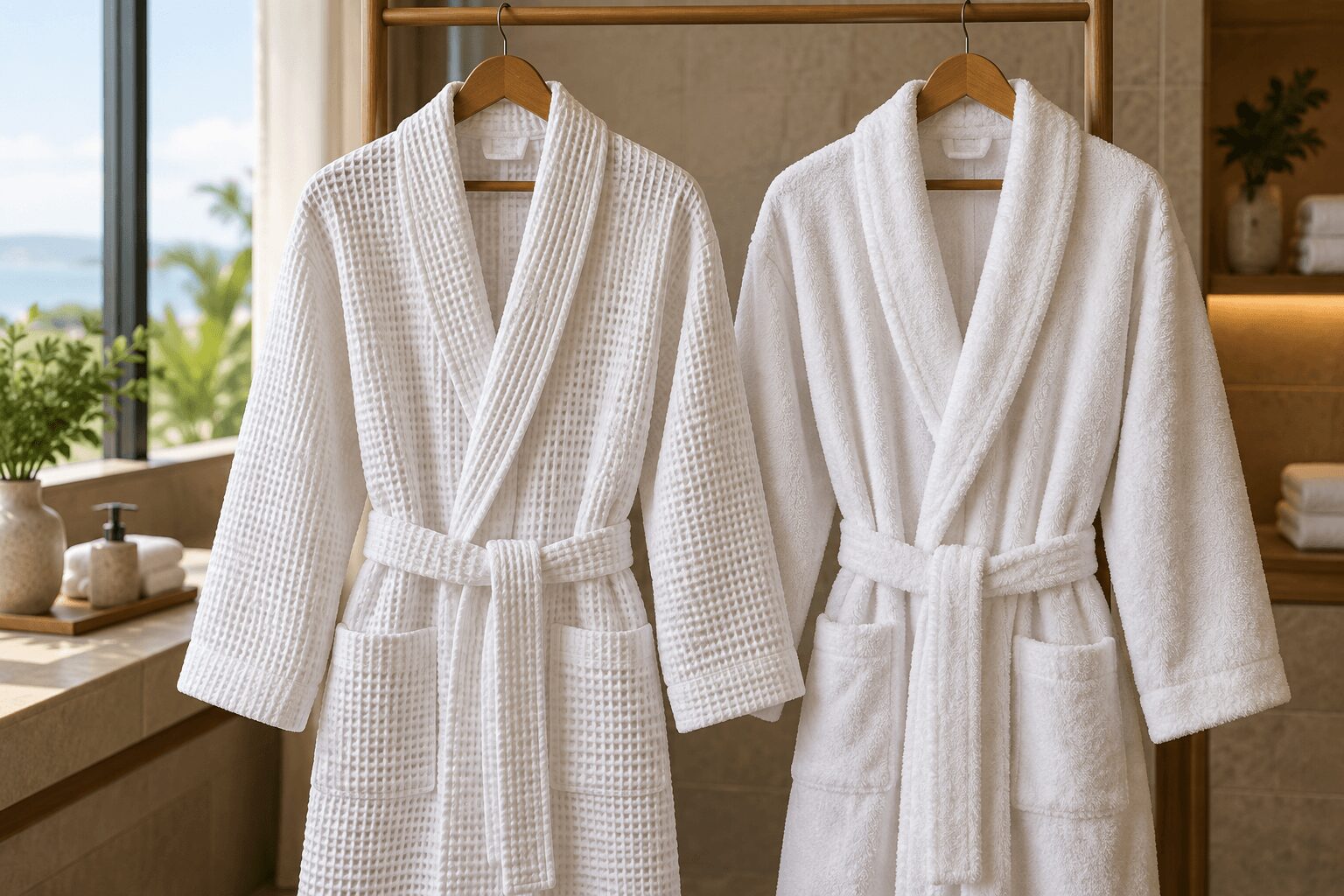
Waffle bathrobe vs terry bathrobe is not simply a light-versus-luxury decision. A buyer should compare fibre composition, finished GSM, surface construction, shrinkage, garment measurements, laundering conditions, trims, packing and target use before comparing price. Two robes that look similar in a sample room can behave very differently after repeated washing. Buyers developing a programme can also review Abtex’s waffle bathrobe manufacturing capability and broader home textile made-ups range.
Buyer takeaway
Start with the job the robe has to do
Waffle is usually the stronger starting point when a programme values a lighter profile, compact storage and fast handling between uses. Terry is usually the stronger starting point when the brief prioritises a fuller towel-like surface and higher moisture-holding capacity. Neither construction is automatically “better”; the approved specification determines performance.
Comparison
Waffle Bathrobe vs Terry Bathrobe: The Short Answer
| Buying factor | Waffle / honeycomb-style robe | Terry robe |
|---|---|---|
| Surface structure | Raised and recessed cellular texture | Projecting pile loops on a ground structure |
| Typical profile | Lighter and less bulky for an equivalent garment size | Fuller, plusher and more towel-like |
| Moisture behaviour | Good surface contact and relatively quick moisture release, depending on construction | High moisture-holding potential because of pile volume |
| Drying behaviour | Often faster at comparable size and care conditions | Often slower because a heavier pile can retain more water |
| Storage & packing | Compact profile can reduce folded bulk | Bulkier folded profile |
| Visual character | Textured, modern, spa-oriented | Classic, plush, luxury-hotel character |
| Good starting applications | Spas, resorts, warm climates, private label, gifting | Luxury rooms, colder climates, bath-focused use |
Do not use GSM alone as a quality grade. Yarn, fibre ratio, loop or cell geometry, finishing, garment pattern and laundering method all affect the finished result.
Construction
How Waffle and Terry Robes Are Structurally Different
A waffle robe uses a cellular surface made by the fabric construction itself. Raised areas and recessed cells create visible texture without the deep projecting pile associated with terry. In sourcing conversations, waffle and honeycomb are often used for closely related cellular constructions, but a buyer should still approve the exact cell size, depth and face appearance rather than relying on the name alone.
Terry fabric is built around pile loops that stand away from the ground structure. Those loops create the familiar towel-like surface. Pile height, loop density, yarn type and finishing all influence softness, absorbency, linting and drying behaviour.
Waffle
Texture with a lower-bulk profile
The cellular surface can give visual depth while keeping the garment comparatively light. This is useful where wardrobe space, packing volume, spa comfort or quick turnaround matter.
Terry
Plush pile with towel-like character
The looped surface gives the robe a fuller hand and can hold more moisture, making terry attractive when the robe is expected to behave more like a wearable bath towel.
Woven waffle or knitted waffle?
Both constructions exist. A woven waffle usually gives a crisper, more structured appearance, while knitted waffle generally gives more stretch and a softer drape. For either option, avoid blanket statements about durability. The buyer should test the actual fabric and finished robe under the intended laundering regime because yarn quality, stitch or weave density, finishing and sewing can change the result materially.
Abtex develops custom waffle bathrobes in 100% cotton and cotton-rich CVC options including 70/30, 60/40 and 52/48. The correct blend should be selected against hand feel, care performance, price position and end use rather than composition alone.
Applications
Where Each Bathrobe Construction Fits Best
Spa & wellness
Waffle is a strong starting point when guests move between treatments and relaxation areas and the operator wants a lighter garment with a textured premium look.
Warm-climate resorts
Waffle can be more comfortable than a very heavy terry robe in warm conditions, while still presenting a hotel-grade appearance.
Luxury guest rooms
Terry remains a classic choice where plush hand feel is part of the room experience. Some programmes use different constructions by room tier or season.
Retail & e-commerce
Waffle photographs with obvious texture and can pack compactly; terry communicates plushness. The target retail price and customer expectation should drive the selection.
Gifting & promotional
A compact waffle construction can be useful where pack presentation, carton utilisation and freight exposure matter.
Institutional programmes
Choose from tested results: dimensional stability, appearance, drying behaviour and replacement economics should matter more than the sample-room impression.
Technical specification
Seven Specifications That Decide Bathrobe Quality
1. Finished fabric weight—and when it is measured
State GSM as a finished requirement and add a tolerance. Do not compare one supplier quoting greige fabric with another quoting finished fabric. A lighter waffle robe and a heavier terry robe can both be correct if they meet the intended programme, but the quotation must be based on the same measurement stage.
2. Fibre composition
100% cotton gives a natural-fibre proposition with strong moisture absorbency. Cotton-rich CVC blends introduce polyester, which may support dimensional stability, drying behaviour, durability and cost control, but the result depends on the full fabric construction. For CVC, always state the exact ratio—“CVC” alone is not a specification.
This composition logic also matters across Abtex’s wider waffle blanket programmes. For a deeper sourcing framework on cellular textiles, see the Waffle Blanket Buyer’s Guide; for composition trade-offs, the cotton vs cotton-polyester blanket comparison explains why fibre ratio must be evaluated together with construction and care conditions.
3. Waffle cell or terry pile specification
For waffle, approve cell width, depth, face and reverse appearance and the required handle. For terry, define pile height, loop appearance and any sheared or velour face. A reference image is not enough; keep an approved physical sample or measurable construction standard.
4. Dimensional stability and finished garment measurements
Robe complaints often appear as sleeve, body-length or front-overlap changes after laundering. Specify finished garment measurements after the agreed wash procedure, plus the maximum acceptable dimensional change. Keep separate limits for length and width where appropriate.
5. Collar, belt, pockets and hanging loop
Define shawl or kimono collar; belt width and length; belt-loop position; inner tie; patch-pocket dimensions and placement; neck hanging loop; sleeve opening; hem depth; and reinforcement points. Make-up details are a frequent source of avoidable variation between repeat orders.
6. Colour, finish and appearance after washing
Use a physical colour standard or an agreed Pantone reference, then specify the required fastness and appearance criteria. For white hotel programmes, define the required shade standard rather than simply writing “optical white.” For coloured retail programmes, confirm whether the target is garment-washed, enzyme-softened, pre-shrunk or otherwise finished.
7. Branding and export packing
Lock woven labels, care and fibre labels, country-of-origin marking, embroidery, hangtags, polybag or alternative packing, barcode position, folding method, carton quantity and carton marks. Private-label development fails when packaging is treated as an afterthought.
A useful RFQ line
Specify the robe as a system, not as “white cotton bathrobe”
Composition + construction + finished GSM + measurements after wash + shrinkage limit + colour + trims + labels + packing + testing + quantity + destination.
Sample approval
How to Evaluate Waffle and Terry Robe Samples Before Bulk
A sample should be treated as a production-control document, not just a sales sample. Before approving the robe, record the incoming garment weight, key measurements, colour reference, hand feel, fabric appearance, seam quality and trim placement. Photograph the robe flat and on a hanger, and keep one signed or sealed reference sample wherever possible.
Then wash and dry the sample using the procedure that will be written into the specification. Re-measure body length, chest, sleeve length, front overlap, pocket position and belt location after conditioning. Check whether the waffle cells remain regular or whether the terry pile shows excessive distortion, lint or flattening. Look at collar roll, pocket corners, belt-loop reinforcement, seam puckering, skipped stitches and twisting as carefully as you look at shrinkage.
Before wash
Record the approved baseline
Measure the robe, confirm GSM or garment weight as agreed, check shade and hand feel, photograph construction details, and verify all labels, trims and packing components against the tech pack.
After wash
Evaluate what the buyer will actually receive in use
Re-measure, inspect appearance and seams, review dimensional change, check colour and surface condition, and note any change in collar shape, belt length, pocket position or overall balance.
For a hospitality programme, repeat testing should reflect the buyer’s own risk profile. A home-laundering test can give standardised comparison data, but an industrial laundry may use different chemistry, temperature, extraction and drying. If the robe is going into a hotel or institutional contract, agree whether a separate commercial-laundry trial is required before bulk approval.
Finally, do not approve only the fabric and assume the garment will behave the same way. Sewing thread, seam construction, binding, collar build-up, pocket reinforcement and mixed-material trims can all influence the washed robe. Approval should therefore cover the finished article as a complete system.
Testing & QA
Use the Correct Test Method for Fabric and Garment Dimensional Change
The original draft referred to ISO 6330 and AATCC TM135 as though both were stand-alone robe shrinkage methods. That is too loose for a technical buyer guide. ISO 6330:2021 defines domestic washing and drying procedures for textile testing. ISO 3759 covers preparation, marking and measuring, while ISO 5077 addresses determination of dimensional change after washing and drying. On the AATCC side, TM135 is for fabrics; TM150 is the corresponding method for garments.
For commercial hospitality laundering, the buyer should define the actual wash chemistry, temperature, mechanical action, extraction and drying conditions rather than assuming a domestic-care method reproduces the property’s laundry. The purpose of a standard method is comparability; the purpose of a programme-specific test is fitness for the intended use.
Also agree the relevant colourfastness, seam and appearance checks, and request reports on the actual quoted construction—not a generic report from a different fabric. Abtex’s quality-control approach is built around order-wise checking against buyer specifications and agreed testing requirements.
Commercial decision
Do Not Compare Unit Price Without Comparing Laundry and Logistics
A lower FOB price does not automatically mean a lower programme cost. Weight and bulk influence freight, warehouse utilisation, linen-room storage and laundry handling. Water retention and drying behaviour influence energy and turnaround. Construction quality and dimensional stability influence replacement rate.
But these should not be stated as universal savings claims. Ask suppliers to provide comparable samples and test the actual robe under your wash process. The commercially relevant question is not “Which fabric dries faster in general?” It is “How does this approved robe perform under our defined wash and dry cycle?” The same principle is used in Abtex’s Thermal Blanket Buyer’s Guide and Thermal Blanket vs Waffle Blanket comparison: product names and GSM alone do not establish end-use performance.
Avoidable errors
Five Bathrobe Sourcing Mistakes That Distort a Quotation
- Comparing different GSM bases. Finished weight and greige weight are not equivalent quotation points.
- Approving only an unwashed sample. Fit and appearance must also be evaluated after the agreed laundering procedure.
- Using “CVC” without a ratio. 70/30 and 52/48 are commercially and technically different fabrics.
- Leaving trims undefined. Collar shape, belt, loops, pocket position, labels and thread construction affect both appearance and cost.
- Approving colour only on screen. Use an agreed physical standard and document fastness requirements.
RFQ checklist
What to Send a Bathrobe Manufacturer for a Comparable Quote
Send the same technical brief to every supplier. That is the only way to compare prices accurately.
Buyer questions
Waffle Bathrobe vs Terry Bathrobe FAQs
Waffle bathrobe vs terry bathrobe: which one should I choose?
Choose from the programme requirements. Waffle is a strong starting point for a lighter, textured robe where compact storage and drying behaviour matter. Terry is a strong starting point where a plush, towel-like hand and high moisture-holding capacity are priorities. Test the actual approved construction before finalising the order.
Is a waffle bathrobe as absorbent as terry?
Not necessarily. Waffle can absorb moisture effectively through its textured surface, but a dense terry pile can hold more total water. Fibre type, GSM, yarn and finishing affect both constructions, so absorbency should be tested on the actual quality being bought.
What GSM should a waffle bathrobe be?
There is no single correct GSM. The appropriate finished weight depends on the desired hand, climate, target price, washing process and retail or hospitality positioning. Specify finished GSM with a tolerance and approve the physical robe rather than buying to a number alone.
Are waffle bathrobes suitable for hotels and spas?
Yes. They can be developed for hotels, resorts, spas and wellness programmes. The final construction should be selected against the property’s required look, laundering process, replacement cycle and guest experience.
Should a waffle robe be cotton or cotton-polyester?
100% cotton supports a natural-fibre, absorbent proposition. Cotton-rich CVC blends can be used where a buyer wants to balance cotton content with care, stability or cost objectives. Always state the exact blend ratio and approve performance on the finished robe.
Which test should be used for bathrobe shrinkage?
For AATCC testing, TM150 is the garment method, while TM135 is for fabrics. Under ISO practice, ISO 6330 provides washing and drying procedures, with ISO 3759 and ISO 5077 used for preparation/measurement and dimensional-change determination. The agreed care procedure must match the buyer’s intended evaluation.
Is waffle weave the same as honeycomb weave?
The terms are frequently used for similar cellular textile structures in commercial sourcing, but suppliers can use them loosely. Buyers should approve the measurable cell construction and a physical reference sample instead of relying on terminology alone.
Can Abtex make private-label waffle bathrobes?
Yes. Abtex develops waffle bathrobes in 100% cotton and cotton-rich CVC options with buyer-defined sizing, colour, labels, branding and packing. Final feasibility, MOQ and lead time should be confirmed against the exact programme.
Start a sourcing conversation
Send Abtex Your Bathrobe Specification
Whichever side of the waffle bathrobe vs terry bathrobe decision fits your programme, the next step is to convert the concept into measurable specifications. Share composition, construction, GSM, sizes, colours, quantity, branding, packing, testing and destination so the quotation is based on the product you actually intend to buy.